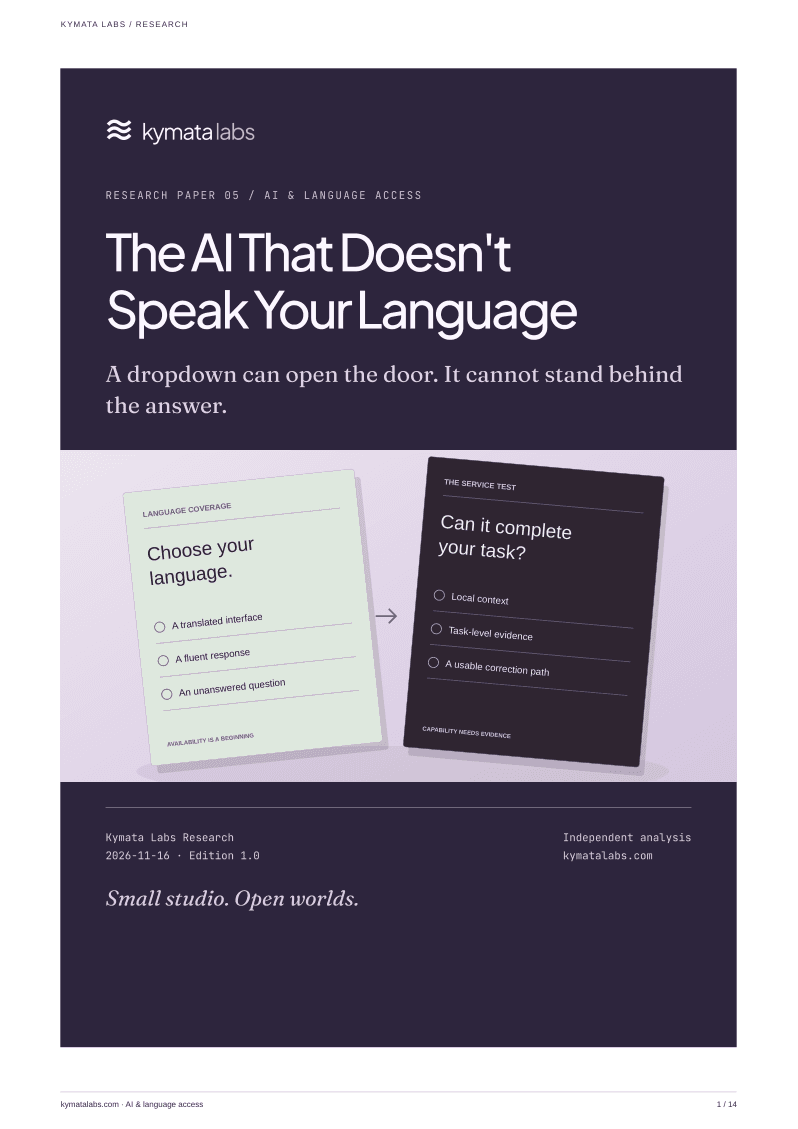
The AI That Doesn't Speak Your Language
A dropdown can open the door. It cannot stand behind the answer.
Read the full white paper PDF · 14 pages ↓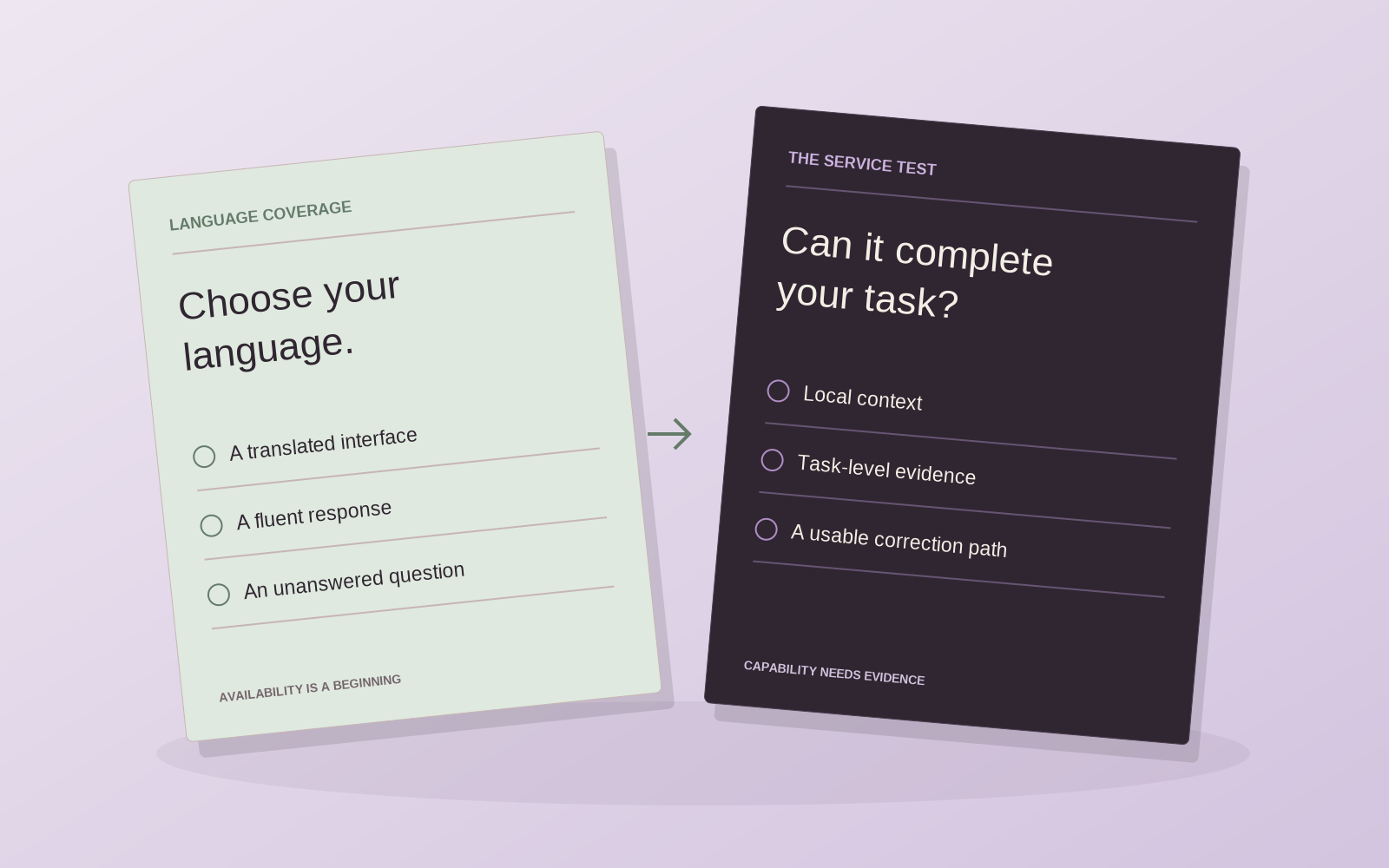 Original editorial illustration · Kymata Labs
Language support should name the task, the evidence and the correction route. A fluent answer proves none of those on its own.
The dropdown makes a promise
A language menu says welcome. In a product that answers questions, it can also suggest something the team has never established: that the answer deserves the same confidence in every language on the list.
A system can display the right script and produce an elegant paragraph while remaining unevaluated for the decision that paragraph helps someone make. The interface works. The service promise is still an open question.
A language listed is not a capability demonstrated, and a capability demonstrated is not a remedy delivered. Multilingual AI becomes an accountability problem when a provider lets those three things blur.
This is not an argument that AI fails outside English, that English answers are reliable, or that speakers should wait for permission to use imperfect tools. The benchmark documentation reviewed here supports a narrower challenge: show what the system can do, under which conditions, and who can help when it is wrong.
What multilingual benchmarks actually establish
XTREME's 2020 documentation describes forty languages and nine tasks, including classification, tagging, retrieval and question answering. Each task covers a subset of those languages. Its standard transfer setting trains on English task data and evaluates the same task in other languages; the BUCC and Tatoeba retrieval tasks instead use pretrained representations directly. Forty languages does not mean nine independently verified capabilities in each one. [1]
FLORES-200 evaluates machine translation. Its 2022 release describes 3,001 sentences from 842 web articles. That is useful evidence for a specific problem. It cannot establish that a service retrieves the right local rule or handles a consequential complaint. An accurate translation can preserve an original error perfectly. [2]
Belebele covers another slice: 900 multiple-choice reading questions per language variant, across 122 variants. Every question has four choices and exactly one correct answer. Its parallel material makes comparisons useful; its task does not test an open-ended assistant confronted with missing evidence. [4]
The language counts belong beside the task definitions. They are not interchangeable measures of how many people a product can responsibly serve.
A language count needs a task beside it.
Four evaluation resources ask different questions. Coverage counts do not measure interchangeable capabilities.
XTREME
40 languages; nine tasks covering subsets. English-task transfer, except retrieval using pretrained representations.
FLORES-200
3,001 sentences from 842 web articles. Tests translation of bounded source material.
TyDi QA
Primary tasks permit no answer; GoldP guarantees an answer passage and removes unanswerable questions.
Belebele
900 questions per variant across 122 variants. Four choices; exactly one correct answer.
Original release definitions, principally 2020–2024. No current model ranking, language-parity estimate or country comparison is shown.
The missing answer disappears before the test
TyDi QA makes the distinction unusually clear. The 2020 dataset describes eleven languages and 204,000 question-answer pairs. Questions were collected directly in each language from people who wanted to know the answer, rather than translated from an English question set. Its primary tasks allow a system to return no answer when the supplied material is insufficient. [3]
The simplified TyDiQA-GoldP task changes those conditions. It supplies a passage guaranteed to contain the answer, discards unanswerable questions and removes Thai and Japanese because the absence of whitespace breaks some tools. The authors explain the compatibility tradeoff and explicitly ask researchers to name the particular task when reporting results. [3]
The problem is not that researchers simplified a task. The problem would be keeping the score while dropping the qualification. A test in which the answer is guaranteed cannot establish when a product should decline to invent one. A tooling accommodation that removes languages cannot become evidence about those languages.
Exclusions must travel with results. Ask what a benchmark made easy before asking how high the score was.
Translation is one link in the chain
Translating a request into another language, answering it there and translating back can be a sensible design. It still needs evaluation as a complete chain.
The first translation must preserve meaning. Retrieval must find the relevant authority. The answer must stay inside that evidence. The return translation must preserve qualifications. The user must then be able to contest a mistake without rebuilding the whole exchange in another language.
Consider an explicitly hypothetical municipal assistant. It translates a document-eligibility question competently, retrieves guidance for a similarly named program elsewhere and returns a clear answer. The failure is source selection and jurisdiction, not necessarily translation. Better sentence translation alone need not fix it.
MLQA's seven-language extractive question-answering resource distinguishes the language of the question from the language of the source context. That is a useful reminder for product teams: the language a system accepts and the language of the evidence it searches are different design choices. [6]
Fluency cannot certify the whole journey.
A multilingual answer depends on several distinct commitments. A polished final sentence does not verify the earlier steps.
Preserve intent
Keep names, conditions, uncertainty and negation intact across language handling.
Find authority
Retrieve the relevant source for the actual question and setting; preserve its identity.
Keep the limits
Stay within the evidence, preserve qualifications and recognize when no answer is supported.
Make repair usable
Retain the exchange, route the dispute and communicate a correction the user can use.
Kymata Labs analytical framework. Source research motivates the task distinctions; it does not measure complaint handling or failures at these transitions.
Who translates the complaint?
Imagine an assistant that speaks the user's language but requires an English form to report an error. The user must notice the defect, explain why it matters and persuade someone outside the original exchange to correct it.
This is a product-design risk, not a measured incident from the reviewed benchmarks. Those benchmarks do not evaluate the institution's complaint process. Their silence cannot establish that a multilingual service has a usable remedy.
A meaningful support claim should include the route back: preserve the original exchange, identify the disputed passage, show reviewers the sources and language setting, and communicate the correction in a form the user can use. The remedy should match the consequence. A drafting aid and a service influencing access to a benefit have different obligations.
This problem is distinct from subscription inequality. A free tool can still make the user its translator of last resort. Paying more does not prove that a correction route exists.
The case for opening the door anyway
Demanding perfect parity before multilingual launch would set a standard many English products never face. It could exclude people from useful assistance while pretending to protect them.
An imperfect tool can help someone draft a letter, understand a paragraph or start research. Users have agency; a provider should not assume that no access is better. The right response is a calibrated promise: make useful functions available, distinguish drafting from authoritative guidance, expose relevant sources and route consequential uncertainty appropriately.
Nor should historical benchmarks become a verdict on today's models. This article uses resources from 2019–2024 to examine evaluation methods. It reports no current model ranking or measured present-day disparity. Better systems can improve outcomes without dissolving the distinction between translation, comprehension and an accountable service.
Replace the language count with a support contract
“Supports Spanish” is too broad to guide a release decision. A useful proposed statement is more concrete: this version summarizes specified documents in tested written varieties, does not decide eligibility, and routes unsupported or conflicting cases to a named review process.
Record the task, source collection, tested language conditions, system versions, limits and correction route. Identify what has not been evaluated. Missing evidence is neither a pass nor a measured failure.
Use matched cases to compare similar tasks across languages, and locally originated cases to surface questions a translated English inventory may miss. TyDi QA's direct collection and Belebele's parallel design illustrate the value of both approaches. [3][4]
Be precise about the evaluation unit. PAWS-X distinguishes human-translated evaluation pairs from machine-translated training pairs and warns that individual sentences can recur across development and test sets even when complete pairs do not overlap. Repeated templates in a local suite likewise need not represent independent kinds of user difficulty. [5]
Preserve the actual prompt and output-processing rules. Belebele's released instruction notes describe choice-letter prompts and normalization of responses such as parenthesized letters. Formatting and comprehension are related but distinguishable outcomes; do not quietly repair one language's responses more generously. [7]
Publish the promise with its proof and remedy.
A useful support statement names a bounded task and carries its evidence and correction route into the product decision.
Promise
Task, source collection, language variety, system version and consequences outside scope.
Proof
Matched and local cases; missing evidence; prompt rules; visible failures and review disagreements.
Remedy
A usable escalation route, preserved evidence, accountable owner and dated re-evaluation.
This is a proposed operating contract, not a completed product evaluation or a legal standard. An untested slice remains unknown.
Test the promise, including the exceptions
For the hypothetical municipal service, test three commitments. Can it summarize the documents actually listed? Can it route an unlisted document to review instead of guessing? Can it handle conflicting notices according to a defined policy rather than choosing the easiest passage?
Review equivalent intents in each tested language condition and add locally originated formulations. Preserve failures, escalations and reviewer disagreement. A correct escalation can be a successful outcome. A smooth answer that invents eligibility cannot.
Report language-and-task slices alongside any aggregate, with sample sizes and limits. Passing a small curated suite is evidence about those cases, not universal competence. MLQA's guidance to disclose evaluation settings and limit repeated test-set use offers a useful discipline: explain what was tested and when tuning has weakened independence. [6]
The question is not simply whether AI can speak your language. It is whether the institution behind it will accept an obligation in that language after the answer matters.
A dropdown can open the door. It cannot stand behind the answer.
Evidence and limits
We inspected original repository task definitions, coverage and evaluation guidance, captured November 16, 2026. We did not read the full linked papers, rerun benchmarks, audit every dataset instance, test current commercial models or interview users. FLORES-200 is discussed as its historical release, not the latest FLORES family. The service example and support contract are explicitly proposed analytical tools. The full white paper develops the accountability argument, evaluation tradeoffs and worked release exercise.
Questions worth asking.
Does this show that AI works poorly in every language except English?
No. We did not test current models or measure a present-day disparity. The paper examines what historical multilingual benchmark tasks establish and what they leave untested. English output also requires task-specific evidence and a usable correction path.
Why does the difference between TyDi QA and TyDiQA-GoldP matter?
The primary tasks allow no-answer outcomes. GoldP provides a passage guaranteed to contain the answer, removes unanswerable questions and excludes Thai and Japanese for tooling compatibility. Its results cannot independently establish no-answer behavior or performance in the excluded languages.
Can translating everything into English solve the problem?
It can be a useful design, but evaluate the full journey. Translation must preserve intent; retrieval must select relevant evidence; the answer must preserve limits; and the user must have a usable correction route. A fluent return translation does not verify source selection.
Should teams wait for perfect language parity before launch?
No universal parity prerequisite is proposed. Useful low-consequence functions can be released with specific limits, appropriate evidence and usable escalation. The release promise should match the task and its consequences; unsupported decisions can be restricted without removing every useful function.
What should a buyer ask a multilingual AI supplier to demonstrate?
Ask for the actual task, source collection, tested language varieties, system version, evaluation conditions and correction route. Review matched and locally originated cases, including missing or conflicting evidence. Keep sample sizes, failures and untested slices visible rather than relying on one language count or overall score.
Sources & method.
Analysis of original benchmark repository documentation and released prompting notes, captured November 16, 2026. We inspected task definitions, language coverage, exclusions and evaluation guidance; we did not read the full linked papers, rerun benchmarks, audit all data, test current commercial models or interview users. Historical release counts are not current capability measurements. The service contract, diagrams and municipal example are explicitly proposed analytical tools.
- XTREME: task coverage and cross-lingual evaluation setting Junjie Hu, Sebastian Ruder, Aditya Siddhant, Graham Neubig, Orhan Firat and Melvin Johnson · 2020 benchmark; repository accessed 2026-11-16 · Primary research repository documentation
Original XTREME task coverage and evaluation setting. Most tasks transfer from English; BUCC and Tatoeba retrieval use pretrained representations directly. README and evaluate.py inspected. Not XTREME-R or a current model ranking.
- FLORES-200: original machine-translation evaluation release NLLB Team / Meta AI · 2022-06-30 release; repository accessed 2026-11-16 · Primary dataset release documentation
Original FLORES-200 composition, splits and language-script inventory. The repository is no longer updated. Its 3,001 sentences and 842 source articles describe this historical release, not current FLORES+ coverage.
- TyDi QA: primary tasks, GoldP exclusions and evaluation guidance Jonathan H. Clark, Eunsol Choi, Michael Collins, Dan Garrette, Tom Kwiatkowski, Vitaly Nikolaev and Jennimaria Palomaki · 2020; GoldP v1.1 released 2020-02-27 · Primary research repository documentation
Primary tasks permit no answer. GoldP removes unanswerable questions and excludes Thai and Japanese for tooling compatibility. README and changelog inspected; the authors require task-specific result names.
- Belebele: parallel multiple-choice reading-comprehension task Lucas Bandarkar and colleagues / Meta AI · ACL 2024 publication; repository accessed 2026-11-16 · Primary research repository documentation
Parallel reading comprehension: 900 questions per variant, 122 variants and four options per question. Task composition, inventory and settings inspected. These are dataset properties, not product-reliability measurements.
- PAWS-X: translated paraphrase data and split caveat Yinfei Yang, Yuan Zhang, Chris Tar and Jason Baldridge / Google Research · EMNLP 2019; repository accessed 2026-11-16 · Primary dataset release documentation
Human-translated evaluation pairs and machine-translated training pairs. The documented split caveat permits recurring first sentences but not identical complete pairs. Used to distinguish evaluation units.
- MLQA: question/context languages and evaluation disclosure Patrick Lewis, Barlas Oğuz, Ruty Rinott, Sebastian Riedel and Holger Schwenk · 2019 research release; repository accessed 2026-11-16 · Primary research repository documentation
Extractive QA across seven languages. Documentation distinguishes question/context languages, requires an answer-language setting and advises disclosure of evaluation conditions. Historical baseline scores are not used as current results.
- Belebele: zero-shot instruction and response-processing notes Belebele research authors / Meta AI · Historical experiment notes; accessed 2026-11-16 · Primary evaluation protocol artifact
Complete released instruction notes inspected. They document choice-letter prompts, model-specific formatting and response normalization. No resulting performance effect is estimated.
The full argument.
Yours to keep.
The developed analysis, evidence, counterarguments and practical framework, in one carefully designed white paper.
14 pages · 3 figures · 7 references · PDFDownload the white paper Free to read. No signup.