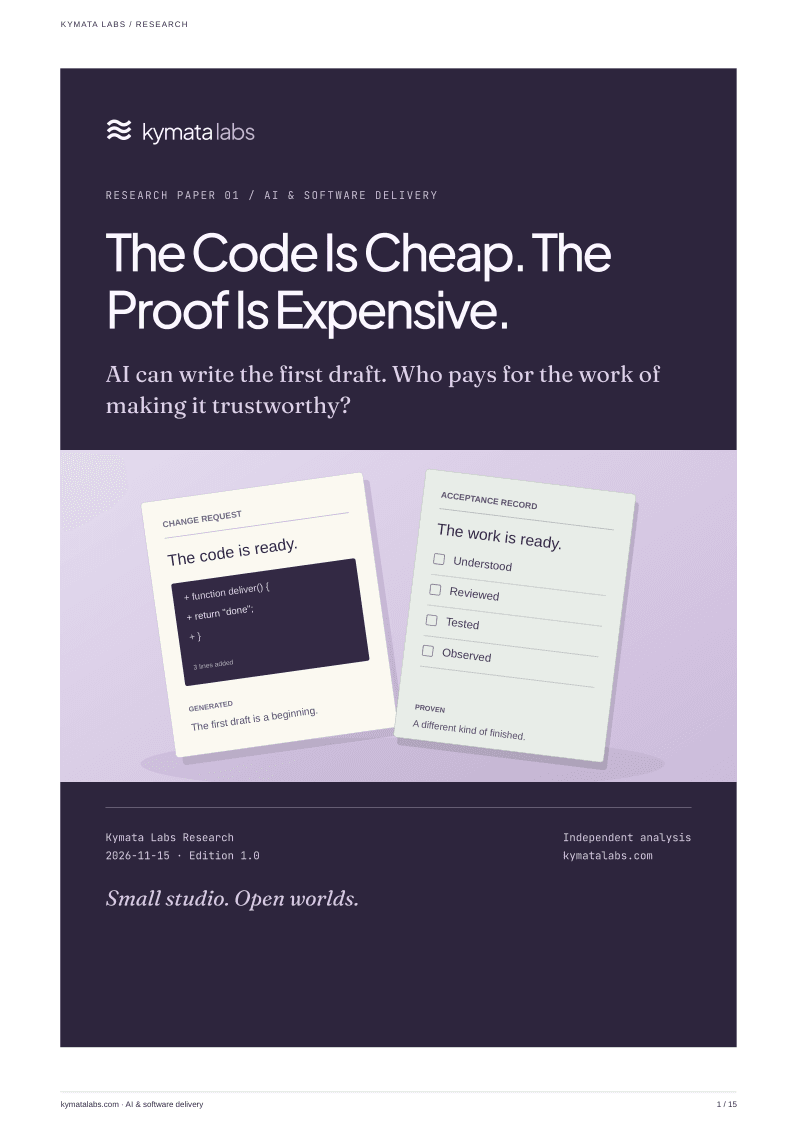
The Code Is Cheap. The Proof Is Expensive.
AI can write the first draft. Who pays for the work of making it trustworthy?
Read the full white paper PDF · 15 pages ↓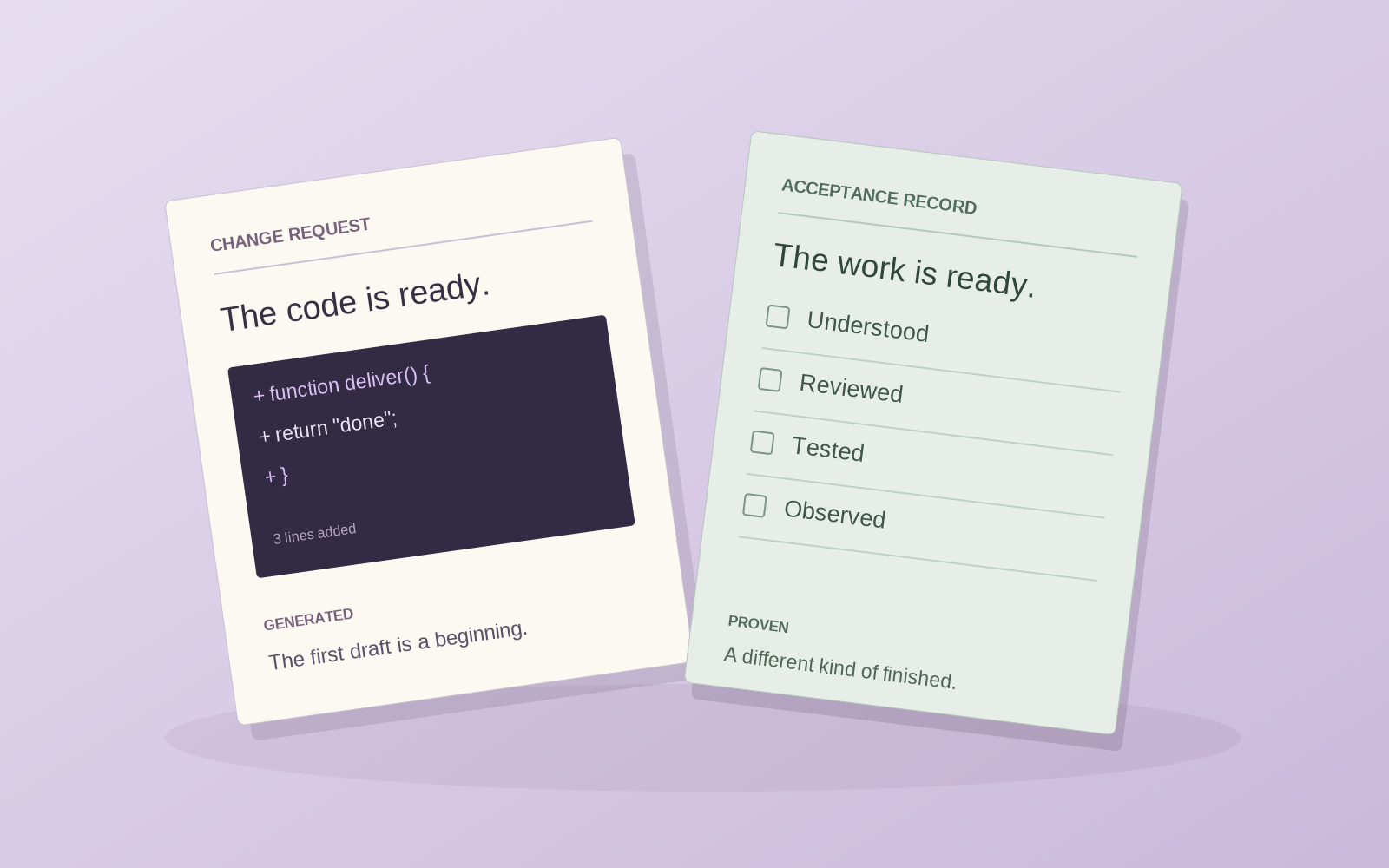 Original editorial illustration · Kymata Labs
The useful unit of AI coding productivity is an accepted, reliable change—not the speed at which a plausible patch appears.
A generated patch can look finished before the difficult work begins. The function exists. The demonstration works. Someone still has to establish whether it solves the right problem, respects the surrounding system, and can be maintained by the next person who touches it.
That distance between a plausible patch and an accepted change is where AI coding productivity should be measured. Assistance can shorten it. Assistance can also create more work inside it. Watching code appear tells us little about which outcome we have bought.
The useful unit is an accepted change against explicit requirements, with the work of reaching acceptance attached. “Proof” means proportionate evidence—tests, inspection, integration checks, and an accountable decision. It does not mean perfect software or mathematical certainty.
What the 18.84% result does—and does not—say
METR’s official early-2025 study repository contains 246 issues completed by 16 experienced open-source developers. There were 136 issues where AI was allowed and 110 where it was not. Reproducing the repository’s core regression gives 18.84% longer implementation time when AI was allowed, with a homoskedastic normal-approximation 95% confidence interval of 1.26% to 39.48% longer. [1]
The date and setting matter. This is a result about early-2025 tools and a particular population, not a verdict on current coding assistants. The repository links its announcement to July 2025. A subsequent repository edit does not make the experiment a new 2026 study.
The measurement boundary matters too. The analysis combines initial implementation time with post-review implementation time: work to prepare a pull request, then work to fix it before merge. It continues past the first draft. It does not include every reviewer’s labor, every hour waiting in a queue, or lifetime maintenance. [1]
The result establishes that tool access and reduced implementation time need not coincide. It does not establish that AI-generated code is universally harder to review, that current tools slow everyone down, or that the observed difference was caused by security defects.
A result with boundaries.
The reproduced adjusted difference in implementation time when AI was allowed, in one study of experienced open-source developers.
Adjusted time difference
Longer implementation time when AI was allowed; not an estimate for today’s tools.
95% confidence interval
Normal approximation, homoskedastic specification. Sixteen developers; 246 issues.
Includes initial and post-review implementation. Does not measure all reviewer labor, waiting time or lifetime maintenance.
Why a convincing patch can remain expensive
Google’s published review guidance asks whether a change belongs in the codebase, integrates with the surrounding system, introduces unnecessary complexity, and comes with useful tests. It asks whether those tests would actually fail when the code is broken. These are engineering criteria, not findings about AI. [2][3]
Consider a hypothetical billing function. A generated implementation might produce the correct totals for every example in its prompt. Acceptance may still depend on rounding rules, currency representation, retries, and existing callers. Establishing those constraints is part of discovering what the function needs to do.
Generated tests can help. They can also encode the same mistaken assumption as the implementation. Passing then demonstrates agreement between the two, without resolving whether either matches the requirement. That logical possibility makes an independent acceptance case valuable; it does not establish that generated tests are generally inferior.
There is another possible bottleneck even when code is correct. If a hypothetical team produces twice as many changes with the same review capacity, work can accumulate before acceptance. That queue would show a mismatch between production and review. It would not show that every additional change lacks value.
The case for genuine savings
Assistance can improve checking as well as drafting. GitHub documents Copilot Chat uses including unit-test generation, proposed fixes, code explanation, and pull-request summaries. It also says generated tests may miss scenarios and still require manual testing and review. These are vendor-documented capabilities and limitations, not independently measured savings. [7]
Nor does every coding evaluation stop at a draft. SWE-bench supplies a workflow for evaluating patches against repository issues. GitHub Next’s public timed-experiment artifact stops its clock when GitHub Classroom records a complete passing test suite. Its toy HTTP task excludes actual network handling, but it has an executable finish line. The inspected artifact contains no effect estimate, so no numerical gain is attributed to it here. [4][6]
When requirements are clear and a trustworthy check is inexpensive, faster generation has a plausible route to lower total effort. When acceptance depends on discovering many undocumented conventions, the route is harder. These are conditions to test locally, not a universal ranking of tools or developers.
Verification is part of the calculation. Its existence is not evidence that gains are absent.
Keep two clocks
Human effort and elapsed delivery time answer different questions. A developer may save an hour while a reviewer spends it. A test suite may run for ten minutes with little active human attention. Two people can review simultaneously, adding labor without adding the same amount of waiting.
Track both clocks and declare the endpoint. A merge is different from a release; a release is different from successful deployment. The Four Keys project provides an established example of measuring delivery through lead time to production and change failures. Its repository is explicitly unmaintained; it is cited here for that measurement perspective, not as the current complete DORA standard. [5]
Before a change begins, record the behavior required, a behavior that must remain intact, the evidence that would distinguish success from a plausible mistake, and the person responsible for acceptance. Then retain effort, timestamps, disposition, and a declared follow-up window.
The acceptance bar should be proportionate and stable. A copy edit and a stateful migration need different evidence. Assisted and unassisted versions of the same work should face the same standard. Google’s review guidance favors changes that improve code health even when they are imperfect; demanding perfection would distort the exercise. [2]
Two clocks. One acceptance decision.
Human effort and calendar time can move differently. Keep both attached to the same, explicitly defined outcome.
Human effort
Author implementation + reviewer inspection + repair. Count person-time without double-counting.
Elapsed delivery
Work begins → ready for review → acceptance → release, when release is the chosen endpoint.
Acceptance contract
Required behavior, protected behavior, checks and a named decision owner.
Keep rejected and unfinished attempts visible. Declare a follow-up window; do not imply later maintenance has been measured.
A faster draft can produce either outcome
Here is a synthetic example, not a measured team result. Three changes each require 40 person-minutes to draft and 20 to check and repair: 180 minutes in total.
With assistance, each draft takes 10 minutes. Checking and repair take 25, 35, and 100 minutes. Drafting effort falls by 75%, but total effort rises to 190 minutes: 5.6% more work.
Now suppose a clearer contract and a focused fixture reduce the third change’s checking and repair to 40 minutes. Assisted effort falls to 130 minutes: 27.8% less work than the baseline. Generation performance is identical in both scenarios. The difference is the cost of reaching acceptance. Building the contract or fixture also costs effort, which must be included or explicitly amortized.
The lesson is not that review inevitably consumes the saving. It is that improving the path to acceptance can make the saving possible. Give the baseline the same engineering improvements when comparing results, so ordinary process improvements are not all credited to AI.
Keep unsuccessful attempts in view too. A rejected change contributes effort but no accepted outcome. Removing it from the dataset makes the workflow look better than it was.
Same drafting gain. Opposite outcomes.
Three fictional changes show why the cost of checking and repair belongs in the productivity calculation.
Baseline
120 drafting + 60 checking and repair.
Assisted scenario A
30 drafting + 160 checking and repair: 5.6% more total effort.
Assisted scenario B
30 drafting + 100 checking and repair: 27.8% less total effort.
Drafting falls 75% in both scenarios. Charge or explicitly amortize the cost of creating better contracts and fixtures in a real evaluation.
Buy the outcome you actually need
A useful local evaluation begins with the decision: adopt a tool for routine maintenance, expand it into larger changes, or assess an existing subscription. Select tasks before seeing their results. Preserve requirements, repository state, configuration, and acceptance checks. Record unfinished and excluded work.
Where practical, assign tasks to assisted or unassisted conditions before implementation. If comparison is observational, say so and consider task mix, familiarity, and environmental changes. Report effort and elapsed time separately, with the number of accepted, rejected, abandoned, and still-open tasks. Keep task scope comparable: splitting one change into several does not create additional value. Record subscription, inference, CI, training, and measurement costs when evaluating a purchase. Follow accepted changes for a declared period rather than implying that merge ends all costs.
This paper reproduces one historical result and proposes a measurement method; it does not validate that method or measure today’s tools. METR’s full paper and announcement were not retrieved in this research environment. Its inspected data and code support the reported reproduction, while the other sources support specific engineering criteria and evaluation boundaries.
The practical question is whether assistance helps this team deliver worthwhile changes at a lower total cost or with a better outcome. Keep the evidence attached to the change, and a genuine saving has somewhere to show up.
Questions worth asking.
Does this mean AI coding tools make developers slower?
No general conclusion follows. The reproduced METR result concerns 16 experienced open-source developers, 246 issues, and early-2025 tools. It cannot estimate the effect of every current tool, task, or team. It is useful evidence that apparent generation speed should be checked against a declared completion boundary. [1]
If the tests pass, why is further review necessary?
Passing tests establish that the inspected implementation satisfies those tests in that environment. Acceptance may also depend on requirements the suite does not express, integration behavior, and maintainability. The appropriate additional review depends on the change. Google’s guidance specifically asks whether tests would fail for broken code; GitHub warns that generated tests may miss scenarios. [3][7]
Can AI reduce the cost of verification itself?
Yes, that is a serious possibility to test. Documented uses include generating tests, suggesting fixes, explaining code, and summarizing changes. Those capabilities can contribute to a lower-effort workflow, but documentation alone does not establish the size of a saving. Include the cost of validating those outputs and apply the same acceptance standard to both conditions. [7]
What should a small team measure first?
Choose one bounded class of work and define what counts as accepted. Record author effort, reviewer and repair effort, elapsed time, and whether each attempt was accepted, abandoned, or remains open. Add a declared follow-up period for attributable repairs. This is a proposed starting method, not a validated universal productivity score.
Is the goal to produce less code?
The goal is to make worthwhile changes easier to deliver. Producing more code may be useful when it creates valuable capability at an acceptable cost. Producing less may be useful when a simpler change meets the same need. Output volume belongs beside evidence of acceptance and value; it cannot substitute for either.
Sources & method.
Analysis of inspected primary research data, evaluation artifacts and engineering documentation. METR’s early-2025 result was reproduced from its official dataset and core regression specification; it does not measure current tools or lifetime maintenance. The acceptance framework and effort scenarios are original proposals, not new experimental findings. Source access: November 16, 2026 UTC.
- Measuring the Impact of Early-2025 AI on Experienced Open-Source Developer Productivity METR · 2025-07-10 · Primary research data and analysis code
Official README, CSV, and regression.py captured at commit 7ff2d7670235f531dff77eff58355bd77392f396. Date is announcement date linked from README. 246 issues, 16 developers; early-2025 setting. Reproduced adjusted time effect 18.839994% with normal homoskedastic 95% CI 1.255985% to 39.477624%. Outcome is initial plus post-review implementation time, not all reviewer labor or lifetime maintenance. Full paper/announcement not retrieved. Sixteen CSV post-review values missing; published treatment-group mean imputation used.
- The Standard of Code Review Google Engineering Practices · Undated; captured 2026-11-16 · Primary engineering guidance
Favors changes improving overall code health even if imperfect; balances progress against quality. Normative engineering criteria, not measured AI productivity evidence. Captured full raw document.
- What to look for in a code review Google Engineering Practices · Undated; captured 2026-11-16 · Primary engineering guidance
Design, functionality, complexity, tests, context and maintenance criteria. Explicitly asks whether tests fail when code is broken. No AI defect-rate inference permitted.
- SWE-bench: Can Language Models Resolve Real-World GitHub Issues? — project README SWE-bench authors and maintainers · Living repository; captured 2026-11-16 · Primary benchmark implementation documentation
README defines repository-plus-issue to patch task and Docker evaluation workflow. No leaderboard score, pass rate, organizational return, or current model comparison claimed. Full README captured; underlying paper not inspected for this article.
- Four Keys — project README DORA team / Four Keys contributors · Undated; captured 2026-11-16 · Primary delivery-metrics implementation documentation
Explicitly unmaintained at capture. Used only as an example of measuring delivery lead time and change failures, not current complete DORA definitions or recommended deployment software. Library release limitations disclosed in source; manuscript does not recommend using package.
- Copilot Timed Experiment GitHub Next · 2022-03-03 repository commit; captured 2026-11-16 · Primary experiment artifact
README, task, tests, and history captured at commit 8ec9e3916cbff3bed32e68e68042e08121989b7a. Timer ends at complete passing GitHub Classroom test suite. Toy HTTP parser/response engine excludes actual network requests. No effect size, participant sample, or full report in inspected artifact; exact linkage to published 2023 study not independently established. No numerical gain cited.
- Application card: GitHub Copilot Chat GitHub · Source revision 2026-10-28; captured 2026-11-16 · Vendor product capability and responsible-use documentation
Official documentation source file. Documents tests, fixes, explanations, and PR summaries, while requiring review and warning generated tests may not cover all scenarios. Capabilities are vendor-described intended uses, not independent measured savings. Atom file history captured; revision date is not a launch date. Rendered docs site not fetched.
The full argument.
Yours to keep.
The developed analysis, evidence, counterarguments and practical framework, in one carefully designed white paper.
15 pages · 3 figures · 7 references · PDFDownload the white paper Free to read. No signup.