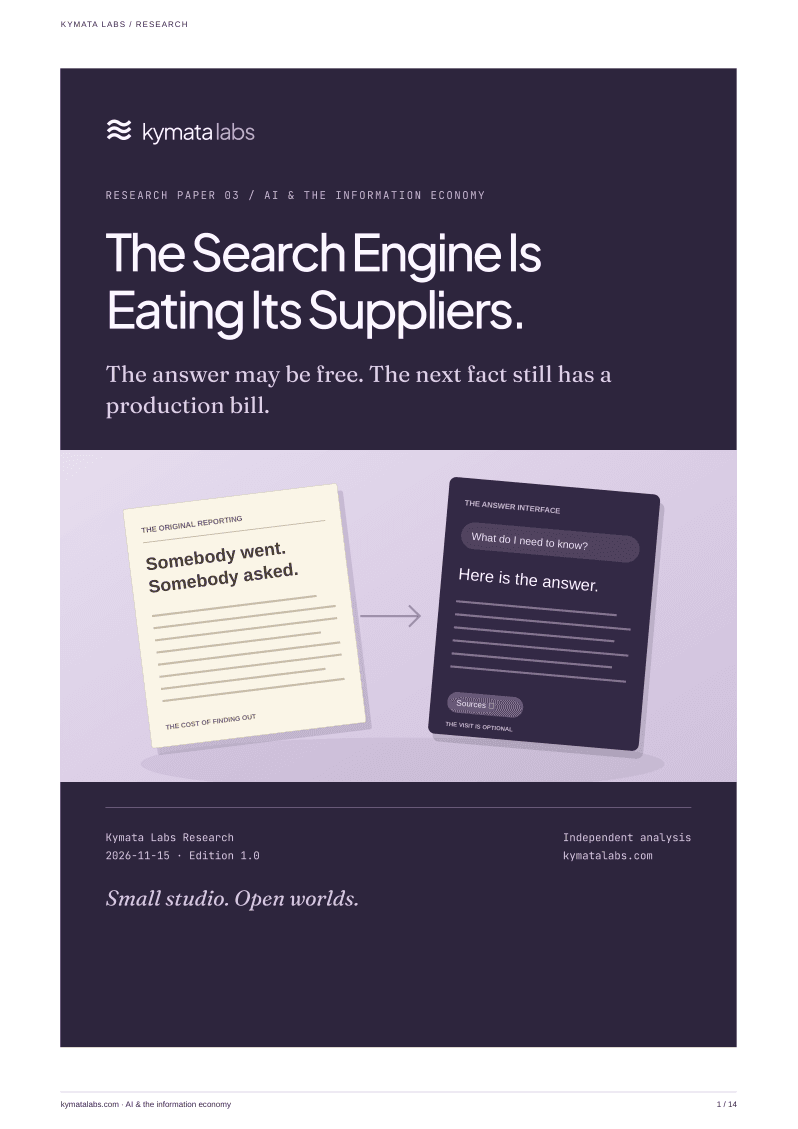
The Search Engine Is Eating Its Suppliers.
The answer may be free. The next fact still has a production bill.
Read the full white paper PDF · 14 pages ↓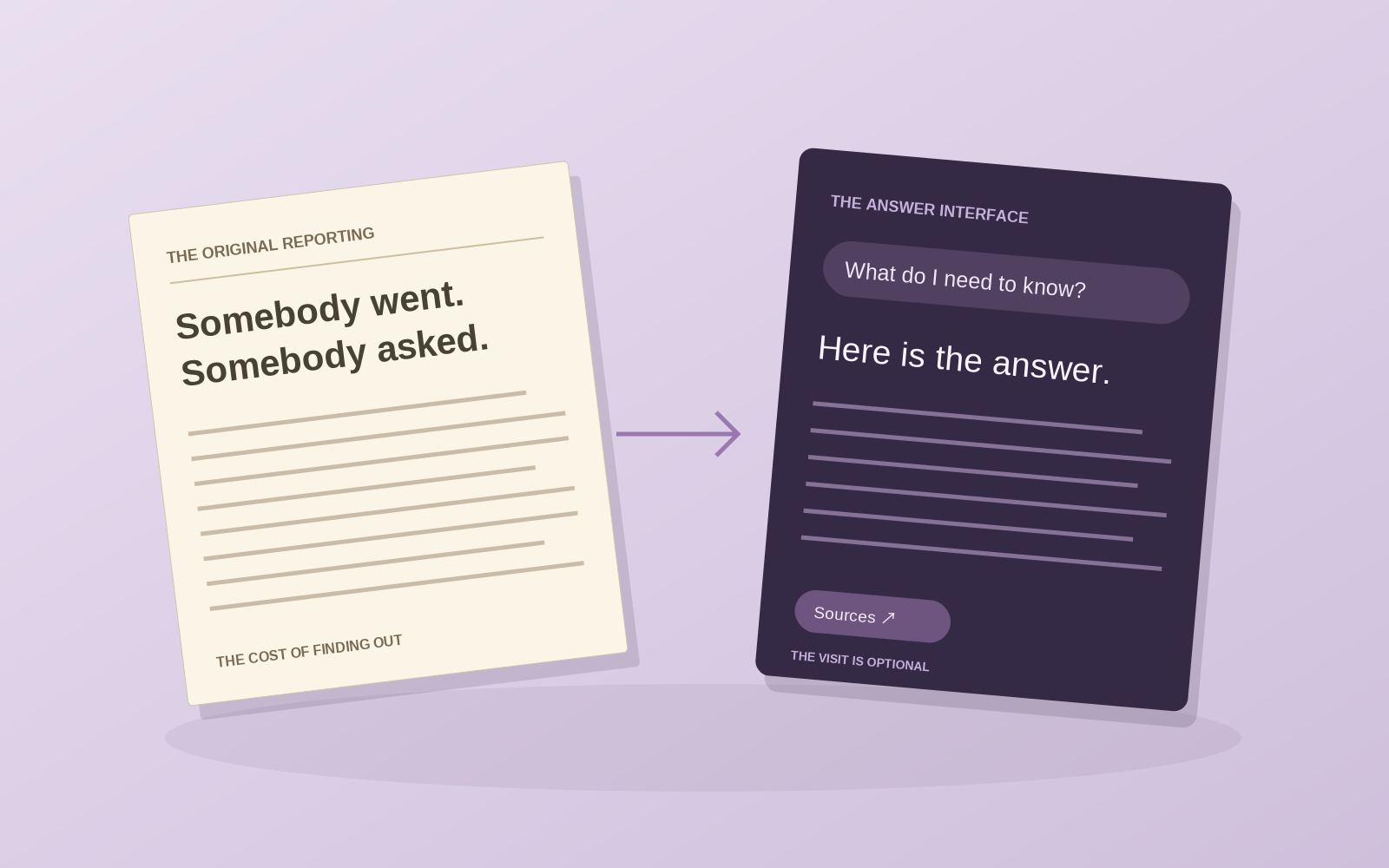 Original editorial illustration · Kymata Labs
A citation is not a visit, and a visit is not funding. Better answers need an observable way to sustain the sources that make them possible.
A search engine can answer your question without sending you to the people who did the work. That can be a better experience. It can also remove the visit that helps pay for the next piece of work.
An explanation, investigation or technical guide has a production cost even when its conclusion fits inside an answer box. Someone gathered the facts, tested the claim or maintained the reference page. Moving consumption into a search interface changes the relationship between that work and its funding.
This is not a claim that AI search has been proved to bankrupt publishers. The research examined here measures answer generation, source selection and advertising exposure. It does not measure an industry-wide causal loss of clicks or income.
The question is more useful than that headline: what replaces the value a source used to receive when the answer moves elsewhere? More valuable referrals might do it. So might licensing, direct subscriptions or paid access. A citation alone does not settle the account.
What a 2026 search study measured
Researchers Haofei Xu, Umar Iqbal and Jacob M. Montgomery released a study of Google AI Overviews covering March 13–April 21, 2026. Its public repository includes 55,393 query executions from 19 US Google Trends categories and 7,583 Overview observations. We inspected the released analysis code and saved results. [1]
Overviews appeared in 13.7% of executions overall. They appeared in 64.7% of queries beginning with the study's defined question words, compared with 9.5% of other queries. Those are cohort results, not estimates for everybody's searches. Sports accounted for 51.4% of the executions, and repeated queries affected the overall rate. [1]
The researchers also examined the sources. Across 61,212 reference occurrences, their analysis detected ads on pages outside its predefined social-platform list accounting for 30,994 occurrences, or 50.63% of the full total. This counts repeated URL appearances across answers. It does not count unique publishers or reader visits. References on that social-platform list remained in the denominator but were excluded from ad detection. [1]
That establishes a material connection between answer generation and sources carrying advertising. It does not establish how many clicks disappeared or what they would have earned. An answer might replace a visit, prompt a valuable visit or serve somebody who would never have opened a source.
The study provides evidence of economic exposure. The financial effect still needs to be measured.
Exposure is measurable. Loss is another question.
AI Overview activation varied sharply across a trends-derived query population. The source and query counts below are different units.
All query executions
7,583 Overviews across 55,393 executions in 19 US Google Trends categories.
Leading question word
2,716 of 4,198 executions; other queries: 4,867 of 51,195, or 9.5%.
References with detected ads
30,994 of 61,212 reference occurrences. Repeated URLs count; social-platform references remain in the denominator.
Sports supplied 51.4% of executions. Ad detection used positive iframe-ad counts outside a predefined social-platform list. No click or revenue loss was measured.
There are four steps between use and funding
A source can be used, credited, visited and paid. These are separate events.
A citation can make an answer easier to verify without attracting a click. A click can produce attention without meaningful revenue. A smaller audience can nevertheless be worth more if it contains more subscribers, customers or people seeking specialist help.
The difficulty begins when all these outcomes are compressed into a single promise of visibility. A publisher cannot pay an editor with citation share. It needs to know whether discovery is becoming a durable relationship and whether that relationship funds production.
Attribution itself needs inspection. The research repository accompanying Liu, Zhang and Liang's 2023 study of generative-search verifiability distinguishes perceived usefulness, statement support and support from individual citations. A useful-sounding answer and a supported answer are different assessment tasks. [2]
The 2026 Overview study similarly classified 11.03% of its 98,020 saved claim judgments as inconsistent with captured source text. These were automated judgments covering 7,491 eligible Overviews, with separate categories for contradiction, omission and ambiguity. The figure is not a measurement that 11% of all Google answers are false. [1]
Even accurate citations may point to a retelling rather than the organization that originated the finding. Replacing one cited page with another does not necessarily replace the costly discovery underneath both. That is why the number of available webpages is an incomplete measure of the health of the information supply.
Four steps between use and funding.
An answer can use a source without completing the economic relationship that supports its next piece of work.
Source used
Information enters the answer. Use does not guarantee visible attribution.
Source credited
The producer is identified. A citation does not guarantee a visit.
Reader visits
Someone reaches the source. A visit does not guarantee contribution.
Work funded
Revenue or other support can help pay for the next investigation or update.
Licensing or paid access can create another path from use to funding. No transition rate or flow volume is implied.
“Better traffic” has to survive multiplication
Consider a hypothetical publication receiving 100,000 referred visits per month. Each contributes $0.10 after visit-related variable costs. Together, those visits supply $10,000 toward reporting, editing and other fixed costs.
Now suppose visits fall to 60,000 while contribution per remaining visit improves by 20%, to $0.12. Total contribution becomes $7,200. The traffic is better per visit and worse in total.
None of these numbers is an observed publisher result or an estimate of AI's impact. They make the accounting visible.
If fixed production costs are $9,000, contribution must reach $0.15 per retained visit to cover them. Restoring the original $10,000 requires approximately $0.1667 per visit—a 66.7% increase over the baseline. Alternatively, $2,800 of additional net monthly licensing contribution would restore the original contribution. So would $2,800 of genuinely additional net contribution from direct relationships.
The general threshold is straightforward. Without another income source, the fraction of visits retained multiplied by the improvement in contribution per visit must reach one. Retaining 80% of visits requires 25% more contribution per visit. Retaining 60% requires about 66.7% more.
The comparison must use consistent costs and time horizons. Counting future subscriber value for AI referrals while counting only first-visit ads for ordinary search would manufacture an improvement. Cutting reporting until expenses fit the smaller revenue base can keep the company alive while reducing the work available to everyone else.
Better traffic still has to pay the bill.
Holding the work constant, better contribution per visit may still leave a gap when fewer visits arrive.
Baseline
Monthly referred visits × contribution per visit = $10,000.
Fewer, higher-value visits
Contribution improves 20% per visit, but the total falls to $7,200.
Restore the baseline
Additional net licensing contribution restores $10,000; $1,800 only covers the assumed $9,000 fixed cost base.
All visits, rates and costs are invented. Contribution is after visit-related variable costs. Compare consistent horizons and charge acquisition costs.
The best defense of answer engines is real
Readers do not owe a website an unnecessary visit. A clear explanation can save time, reduce confusion and help someone find an expert. Preserving every page-view opportunity would also preserve pages that make users work unnecessarily hard to get an answer.
Answer engines may broaden discovery. In the 2026 study, the average overlap between Overview citation domains and the full captured search-result links was 70.2%. The remaining 29.8% describes citation domains absent from those links within an observation; it is not a measured gain in visits. Still, an answer can introduce sources beyond the visible result set. [1]
The source-quality findings were mixed in a useful way. Cited sources scored higher than the full captured link set on the study's available credibility scores. In query-paired comparisons, however, their averages were lower than the top one, three or five captured links. The claim changes with the comparison. Score coverage was incomplete, and the captured links were not a separately classified list of organic results. [1]
Better referrals can also matter. Someone who has already understood a problem may arrive ready to subscribe or buy. That can benefit a specialist publication or business. The appropriate response is to measure contribution and retention, not dismiss the possibility because total visits fell.
Nor is traffic the only possible compensation. If a licensing arrangement funds reliable updates and original work, the reader need not open a separate webpage for the exchange to be economically sustainable.
Useful answers and funded sources are compatible. Compatibility needs an actual mechanism.
Paid crawling is a beginning, not proof of sustainability
Cloudflare documents a Pay Per Crawl feature in closed beta. Site owners can set a price for crawler access. A crawler can present payment intent or receive an HTTP 402 Payment Required response with pricing. Cloudflare acts as merchant of record. That is a concrete way to connect access with payment. It is not evidence of widespread adoption or sufficient publisher income. [5]
One crawl is not one answer. A fetched page may support multiple uses, while one answer may depend on many pages. Payments must account for what is licensed, how updates work and what the producer can inspect.
Distribution matters as much as mechanism. A large archive may negotiate an agreement that a small specialist cannot. Paying the final fetched page may overlook the original reporting repeated there. A replacement for referral funding should support new useful sources as well as established ones.
Publishers also have controls. Cloudflare describes crawler-specific allow, block and charging options, along with analytics that separate crawler requests from referral visits. Its documentation recognizes that citations, referrals and existing agreements can provide different kinds of value. [4][6]
Its Content Signals vocabulary also distinguishes search indexing, real-time AI input and training. These categories help publishers express preferences; they do not establish universal legal rights or guarantee compliance. Even a violation dashboard needs care: Cloudflare warns that comparing historical requests with current robots.txt rules can flag requests that were allowed when made. [7][8]
Measure what keeps the work coming
Publishers need to connect four records: crawler access, observed answer citations, identifiable human referrals and financial contribution. Keep comparable page cohorts and note changes in publication frequency, demand and search rankings. A before-and-after traffic chart alone cannot identify the cause of a decline.
Citation optimization belongs inside that measurement, not above it. The GEO research project reports source-visibility improvements of up to 40% under its evaluation measures. It does not establish equivalent increases in visitors or revenue. Making a page easier to cite can be useful; treating that as a business outcome skips the essential step. [3]
Platforms can help by reporting source use, separating citation display from reader action and making compensation auditable. Clear attribution and links should help readers find the original work and inspect its qualifications. Corrections should remain connected to the material that supplied the answer.
The longer-term risk is a quieter change than a publisher disappearing overnight. An archive may remain while its owner stops commissioning new reporting. A useful guide may stay online while nobody is paid to update it. Those are incentive risks, not outcomes measured by the studies reviewed here.
The full white paper develops the evidence, the competing case and the transparent economic model. Its central test is simple: can the new interface improve the reader's experience while funding the next piece of reliable information?
The answer may be free at the point of use. The next fact still has a production bill.
Questions worth asking.
Does this paper prove AI Overviews reduce publisher revenue?
No. The inspected 2026 study measures answer activation, sources, captured-source support and advertising exposure. It does not measure a causal publisher click or revenue loss. The economic model is explicitly hypothetical.
Can fewer visits still be better for a publisher?
Yes, if each remaining visit contributes enough value, or another income source fills the gap. Retaining 60% of visits requires about 66.7% more contribution per visit to preserve the old total without additional income. Use the same cost rules and time horizon for both channels.
Is getting cited in AI answers enough?
A citation can provide recognition and a route to verification. It does not guarantee that the claim is supported, a reader visits, or the publisher earns revenue. Track those outcomes separately.
Can publishers charge AI crawlers?
Cloudflare documents Pay Per Crawl in closed beta, with pricing and payment-intent or HTTP 402 flows. That establishes a possible mechanism; it does not establish universal access to the feature, widespread payment or sustainable publisher income.
Should publishers block AI crawlers?
Decide by service, purpose and measured return. Separate indexing, real-time answer retrieval and training; record the rules in effect and compare crawler access, referrals and financial contribution. A blanket rule may fit some publishers and undermine discovery for others.
Sources & method.
Analysis of original research repositories, saved outputs and official documentation. The 2026 search study covers a historical, trends-derived query cohort; its full raw pipeline was not independently rerun. No new search crawl, publisher interview or causal estimate of traffic or revenue loss is claimed. Financial scenarios are explicitly hypothetical. Source access: November 16, 2026 UTC.
- Measuring Google AI Overviews: Activation, Source Quality, Claim Fidelity, and Publisher Impact — released research repository Haofei Xu, Umar Iqbal and Jacob M. Montgomery; IMC 2026 · 2026; repository release 2026-11-04 · Primary research: original code, saved notebook outputs and study documentation
DOI 10.1145/3777912.3839818. March 13–April 21, 2026; 55,393 query executions, 7,583 Overviews, 19 US Google Trends categories. Inspected README, scraper/verifier documentation and notebooks01,03–07. Full raw pipeline not independently rerun. Does not measure publisher click or revenue loss.
- Evaluating Verifiability in Generative Search Engines — accompanying material Nelson F. Liu, Tianyi Zhang and Percy Liang · 2023 · Primary research artifact
Inspected original README and acquired public human-evaluation annotations. Used for explicit distinctions among usefulness, statement support and individual-citation support; no current performance claim.
- GEO: Generative Engine Optimization — research repository Pranjal Aggarwal, Vishvak Murahari, Tanmay Rajpurohit, Ashwin Kalyan, Karthik R Narasimhan and Ameet Deshpande · 2023 research; accessed 2026-11-16 · Primary research artifact
Original README reports source-visibility improvements up to 40% under project evaluations. This is not an estimate of traffic, conversion or revenue gains. Original README and project-page source were inspected; the evaluation was not rerun and no paid model calls were made.
- Analyze AI traffic Cloudflare · Undated documentation; accessed 2026-11-16 · Official product documentation
Inspected official cloudflare/cloudflare-docs production source. Distinguishes crawler requests from referral visits; documentation is capability evidence, not measured adoption or publisher outcomes.
- What is Pay Per Crawl? Cloudflare · Undated documentation; accessed 2026-11-16 · Official product documentation
Inspected official repository source. Explicitly closed beta; price per zone; payment-intent headers or HTTP 402 pricing response; Cloudflare merchant of record. No revenue/adoption inference.
- Manage AI crawlers Cloudflare · Undated documentation; accessed 2026-11-16 · Official product documentation
Inspected official repository source describing allow, block and charge options and possible value from citations, referrals or agreements.
- Managed robots.txt — Content Signals Policy Cloudflare · Undated documentation; accessed 2026-11-16 · Official product documentation
Inspected official repository source. Describes search, ai-input and ai-train use categories. Signals are not evidence of universal compliance or a legal conclusion.
- Track robots.txt Cloudflare · Undated documentation; accessed 2026-11-16 · Official product documentation
Inspected official repository source. Explicitly warns violation table compares current directives with past requests, which can flag previously legitimate access.
The full argument.
Yours to keep.
The developed analysis, evidence, counterarguments and practical framework, in one carefully designed white paper.
14 pages · 3 figures · 8 references · PDFDownload the white paper Free to read. No signup.