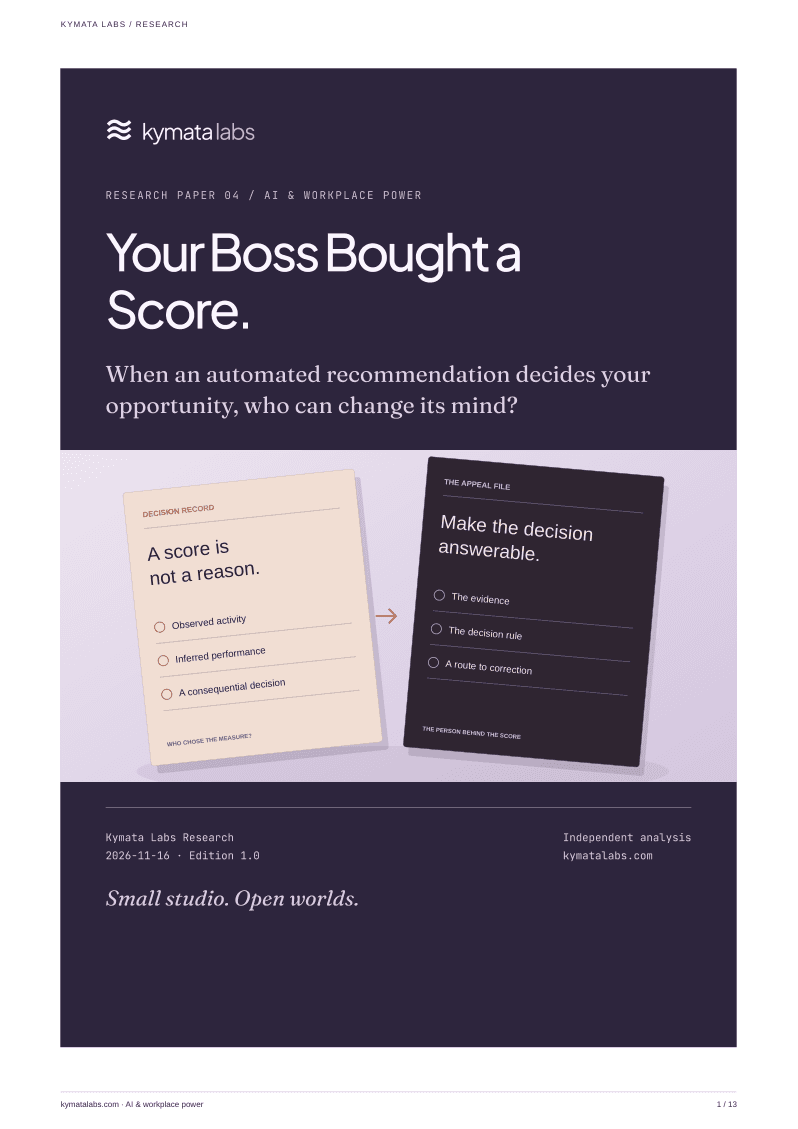
Your Boss Bought a Score.
When an automated recommendation decides your opportunity, who can change its mind?
Read the full white paper PDF · 13 pages ↓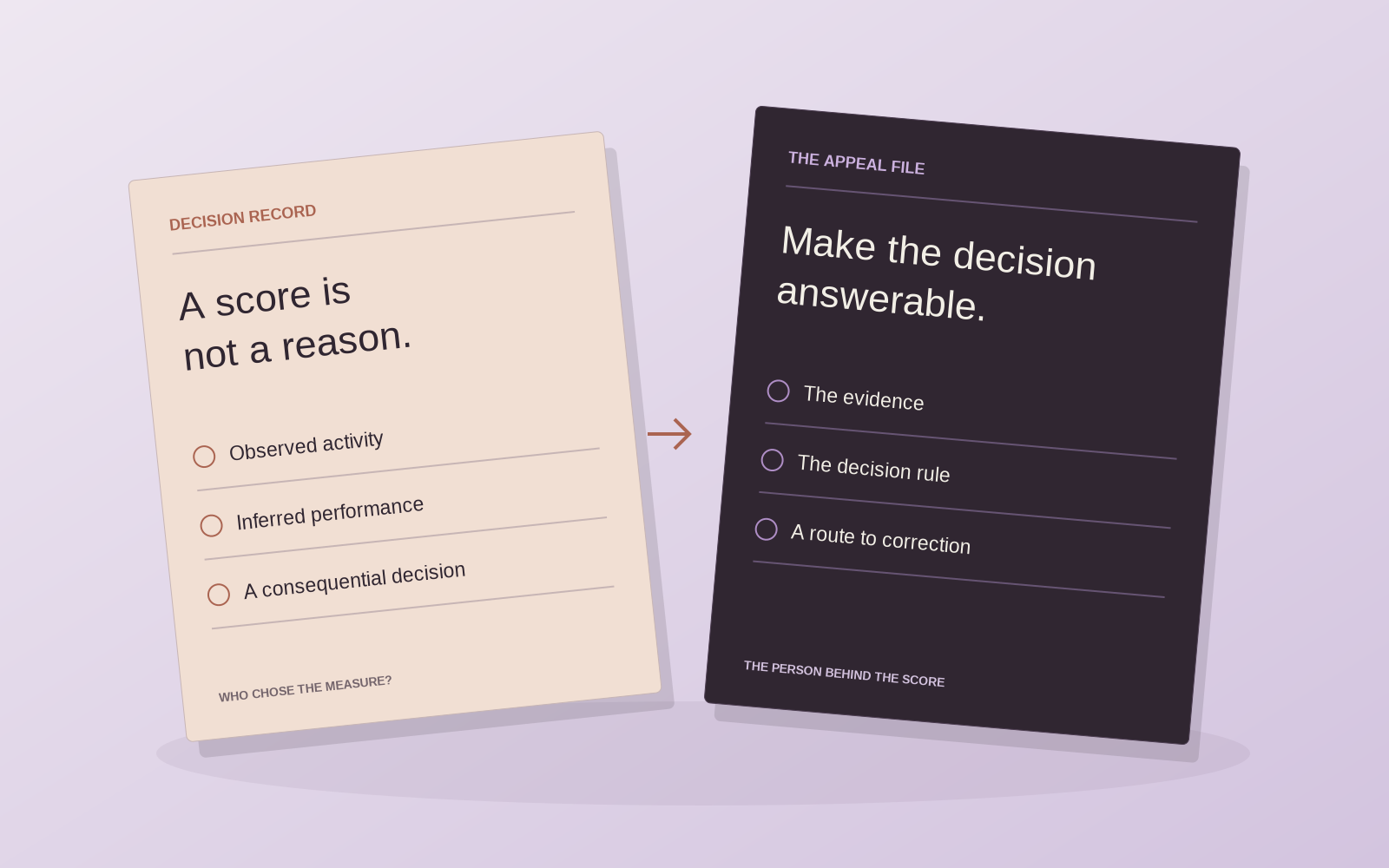 Original editorial illustration · Kymata Labs
Buying a workplace score should mean buying the evidence, authority and remedy needed to correct the decisions that depend on it.
The most consequential feature of a workplace scoring system may be the one absent from the product demonstration: a working way to challenge its decision.
Imagine an employee omitted from a promotion shortlist because a substantial project is missing from their record. This is a hypothetical, not a reported case. The model might have processed the available information exactly as designed. The manager might have approved the shortlist. The supplier might describe its output as advisory. None of those facts would restore the missing project—or the opportunity.
An employer buying a score should also buy the capacity to correct the decisions that depend on it. That means more than explainable AI, more than a fairness dashboard, and more than a promise that a human remains involved. It means a recoverable record, an authorized reviewer, and a remedy that can arrive while it still matters.
AI employee scores: what is being predicted?
“Potential” is an attractive dashboard label. It is not a self-defining measurement. A system might predict past promotion decisions, future manager ratings, revenue, or retention. Each target answers a different question. Calling all of them performance would conceal the choice that made the prediction possible.
Fairlearn's primary documentation describes this problem through construct validity: whether the measurement meaningfully represents the intended concept. Its job-screening example asks whether “qualified” is a valid label before proposing a metric for qualified candidates screened out. [1][2]
For a hypothetical promotion model trained on previous managers' selections, successful evaluation could show that it reproduces those selections under the test conditions. It would not independently establish that the old selections captured merit. A convincing prediction can preserve a questionable definition.
The employer should be able to state the target, population, time horizon, missing information, and evidence that would count against the measure. Without those details, the score asks for trust before explaining what it knows.
The cutoff is a management decision
A model output and a workplace decision are separate objects. The organization chooses how to use a ranking, how many places exist, what other evidence matters, and whether exceptions are possible. Those choices determine the consequence.
Fairlearn's ThresholdOptimizer makes the distinction technically visible: it applies group-specific thresholds to an existing predictor according to an objective and fairness constraints. The documentation describes tradeoffs and requires sensitive features at prediction time. [6] This is an example of the mechanism, not a recommendation that employers use that method or a claim that doing so would be lawful in every setting.
The same score can suggest a second look or block someone from being considered. “Decision support” is too broad a description to distinguish those uses. A manager may retain final authority while seeing only a prefiltered list. In that arrangement, the important exclusion happens before the manager clicks anything.
Our proposed decision record therefore separates the target, the score, the decision rule, and the action. An accountable owner must connect them. A model supplier's responsibility for its output does not remove the employer's responsibility for the use it chooses.
A score does not choose its consequences.
Keep the prediction separate from the organizational choices that turn it into an opportunity or an exclusion.
Target
What outcome is being predicted? Preserve the label and its limits.
Score
Retain the relevant inputs and the model version used.
Rule
Identify the cutoff, ranking policy and exception owner.
Action
Record the actual consequence and who authorized it.
An analytical framework, not a measured employer workflow. Threshold methods illustrate the distinction; they are not endorsed for employment use.
A bias audit is not an answer to every objection
Fairness assessment is valuable precisely when its scope is clear. Demographic parity compares selection rates between groups. Equalized odds compares true-positive and false-positive rates. Equal opportunity focuses on true-positive rates. These are different criteria; error-based measures also depend on the meaning of the labels treated as correct. [3]
The right question after “we passed the audit” is therefore: which groups, outcome, dataset, criterion, and uncertainty? A group-level result does not establish that an individual employee's record is accurate. Correcting that employee's record does not establish that the system's treatment of groups is acceptable.
Aequitas's auditing interface makes its inputs explicit: target labels, model outputs, and sensitive attributes. Users select metrics relevant to the question they are examining. [7] It provides useful machinery for assessment. It does not decide whether a missing project belongs in a promotion discussion.
Fairlearn itself warns that mathematical group criteria cannot capture every individual experience or procedural justice. It also warns against treating a familiar numerical threshold as a universal fairness or legal guarantee. [1][3] Our argument concerns governance; it does not establish anyone's rights under current employment law.
What a real appeal needs
Return to the employee with the missing project. “A person will review your concern” could mean several things. A reviewer might see only today's dashboard, after the original inputs and model have changed. They might be able to rerun the score but lack authority to reconsider the decision. Or they might be able to recover the original record, correct the omission, assess its consequence, and deliver a remedy.
Only the last arrangement completes the chain. We propose four connected requirements:
- Notice that identifies the decision, its consequence, and the responsible owner.
- Evidence sufficient to understand and check the relevant record and criterion.
- Authority to correct material errors and reconsider their use.
- A remedy or reasoned outcome, delivered within a meaningful timeframe.
An explanation can be accurate without being adequate. “The project was absent from the data” explains the lower score. It does not justify excluding the project. “You fell below the cutoff” explains the rule. It does not establish that the rule was suitable for the decision.
An appeal needs a complete chain.
A complaint channel can change a decision only when each link has an owner and usable evidence.
Notice
Identify the decision, consequence and responsible owner.
Evidence
Recover the relevant record, criterion and historical version.
Authority
Give a reviewer power to correct facts and reconsider use.
Remedy
Deliver a reasoned outcome while correction can still matter.
Role-based access and defined retention protect personnel information. A group-level metric cannot replace an individual review.
Access should be proportionate. An employee needs relevant information about their own case, not unrestricted access to colleagues' personnel files. A reviewer may need controlled access to additional records. Retention should preserve enough evidence to investigate under a defined policy, rather than turning every decision into an excuse to collect everything forever.
Review also needs resources. A contact form without reviewer time, independence where needed, and decision authority can accept complaints indefinitely while changing nothing. That is a design failure, regardless of how polished the explanation looks.
Small groups need visible uncertainty
Appeals and aggregate monitoring serve different purposes. An absence of complaints cannot establish that the process is sound; some errors may be difficult for affected people to discover.
Fairlearn recommends examining relevant groups and their intersections, while including counts because some intersections have very few members or none. [2][4] A company-wide average cannot manufacture evidence for a small group in a particular role. Displaying a disparity without its denominator invites overinterpretation; hiding the group erases the uncertainty instead of resolving it.
Confidence intervals help describe sampling uncertainty. They do not repair unrepresentative data. Fairlearn's bootstrap documentation explicitly distinguishes more precise resampling from a more accurate underlying sample, and warns that overlapping intervals do not establish equality. [5]
When the available evidence cannot support the intended use, our proposed response is to narrow the system's authority, improve the evidence where appropriate, or choose another process. Uncertainty is neither proof of discrimination nor a clean bill of health.
The strongest case for automation
The alternative is not a flawless human manager. Human-only decisions can be inconsistent and poorly documented. Automated recommendations could make criteria explicit, expose missing information, and support repeatable checks. Inspectable tools such as Fairlearn and Aequitas make blanket claims that such systems cannot be audited too crude. [2][7]
The buyer's test should compare the real proposed workflow with the real alternative. Examine relevant outcomes, errors, review costs, and correction capacity. Apply stronger safeguards where consequences are harder to reverse. A recommendation for optional training and an exclusion from advancement should not receive identical treatment simply because both use software.
A human in the workflow needs the information, time, and authority to disagree. Their presence alone cannot establish effective oversight. That is an institutional design question, not a checkbox beside a model name.
Before buying, demonstrate a correction
Procurement should include three demonstrations: trace a recommendation into its eventual action; introduce a known error in an authorized test record and show how it is corrected; then show how a repeated failure changes policy or pauses use.
Test whether the system can change its mind.
Use synthetic or authorized records to test accountability before attaching consequential decisions to a score.
Trace a decision
Follow target → input → score → rule → action, with owners.
Correct an error
Repair a known omission and assess the original consequence.
Fix the pattern
Find related failures; revise policy or pause use when needed.
These are unvalidated governance tests, not completed workplace experiments or a legal compliance certificate.
Can the reviewer recover the original version? Does a correction reach downstream systems? Can the decision change without silently overwriting its history? Is someone responsible for finding other decisions affected by the same failure? These questions test whether accountability is part of the product and operating process.
This analysis uses seven inspected documents from two official software projects, not seven independent studies. It reports no employer investigation, model experiment, prevalence estimate, or legal conclusion. The promotion example and review framework are explicitly hypothetical and proposed. The full white paper develops the decision record, privacy tradeoffs, counterarguments, and procurement tests.
A workplace score becomes powerful because an organization gives it consequences. The company must be capable of changing its mind when the evidence changes. Otherwise, it has purchased a way to make decisions look objective while making responsibility harder to find.
Questions worth asking.
Does an employer need AI to make an unfair decision?
No. Human-only processes can also be inconsistent, poorly recorded and difficult to challenge. The appropriate comparison is the proposed workflow against the actual alternative, including outcomes, errors and the ability to correct mistakes. This article does not estimate whether automated or human decisions are generally fairer.
Does passing a bias audit mean the score is fair?
Only a claim within the audit’s stated scope is supported. Selection-rate and error-rate metrics answer different questions and depend on groups, data, labels and uncertainty. Group-level results do not establish that every individual record is correct or that a meaningful appeal exists. A numerical threshold is not a universal legal guarantee. [1][3]
What should someone be able to challenge about an AI employee score?
Our proposed process covers material input errors, whether the criterion fits the decision, how the policy was applied, and the consequence that followed. A reviewer needs relevant evidence and authority to act. These are governance recommendations, not a statement of rights available in every jurisdiction.
Would meaningful transparency expose coworkers’ private information?
It need not. Different roles can receive different access: the employee gets relevant information about their own case, an authorized reviewer can inspect necessary additional evidence, and public reporting can remain aggregate. The paper proposes limited retention and access controls rather than indiscriminate disclosure.
What should a buyer ask the vendor to demonstrate?
Trace a representative recommendation into its action, correct a known material error in an authorized test record, and show how a recurring failure changes the process. Verify historical versions, reviewer authority, downstream correction and a meaningful remedy. These proposed demonstrations test the operating process; they are not validated proof of fairness or legal compliance.
Sources & method.
Mechanism analysis of seven inspected documents from two official software projects, Fairlearn and Aequitas, captured at exact repository revisions on November 16, 2026. No workplace model, personnel dataset or employer case was tested. The promotion scenario and governance framework are explicitly hypothetical and proposed; no adoption, discrimination prevalence or current legal conclusion is inferred.
- Fairness in Machine Learning Fairlearn contributors · Undated living documentation; captured 2026-11-16 · Primary software documentation
Official repository commit f75ec4c4c45c42836516f35f5acf29272c635b09. Definitions of allocation harms and construct validity; inspected lines 7–155 and 275–400, particularly the formalism-trap warning that group metrics omit individual experiences and procedural justice. Conceptual documentation, not workplace prevalence or a legal standard. Underlying cited academic papers were not independently inspected.
- Performing a Fairness Assessment Fairlearn contributors · Undated living documentation; captured 2026-11-16 · Primary software documentation
Official repository commit f75ec4c4c45c42836516f35f5acf29272c635b09. Inspected lines 7–175: harms-first assessment, relevant groups and intersections, hiring false-negative example conditioned on construct validity of qualified, proxy validity, disaggregated metrics and group counts. No employee data or model was evaluated for this publication.
- Common fairness metrics Fairlearn contributors · Undated living documentation; captured 2026-11-16 · Primary software documentation
Official repository commit f75ec4c4c45c42836516f35f5acf29272c635b09. Inspected demographic parity definition, equalized odds and equal opportunity sections, target-label caveat, and warning against universal use of the four-fifths threshold (lines 33–61, 201–310, 314–343). Used for metric distinctions and limitations, not legal advice. Does not establish any employer passed or failed an audit.
- Intersecting Groups Fairlearn contributors · Undated living documentation; captured 2026-11-16 · Primary software documentation
Official repository commit f75ec4c4c45c42836516f35f5acf29272c635b09. Inspected lines 7–150: small or empty intersections, counts, sensitive versus control features, and warning that control features can relate to historic discrimination. Workplace examples in our paper are analytical applications, not cases from this source.
- Confidence Interval Estimation Fairlearn contributors · Undated living documentation; captured 2026-11-16 · Primary software documentation
Official repository commit f75ec4c4c45c42836516f35f5acf29272c635b09. Inspected lines 7–96: bootstrap resampling, reliance on sample representativeness, more precision not necessarily more accuracy, overlapping intervals not evidence of equality. No interval estimated by Kymata; no numeric example from this source is presented as a workplace result.
- Postprocessing: Threshold optimizer Fairlearn contributors · Undated living documentation; captured 2026-11-16 · Primary software documentation
Official repository commit f75ec4c4c45c42836516f35f5acf29272c635b09. Inspected lines 7–45: group-specific thresholds, objective and constraint choices, possible performance tradeoffs, sensitive features required at prediction time, randomization between thresholds. Technical mechanism only; no claim of guaranteed population fairness, lawful employment suitability, or recommended use.
- Aequitas: Bias Auditing & Correction Toolkit — auditing interface DSSG / Aequitas contributors · Undated living documentation; captured 2026-11-16 · Primary software documentation
Official repository commit b35e9d5fafc3844c6761f1f5b39f5f7669391425. Inspected README lines 7–12 and 44–85: stated binary-classification scope, auditing inputs label_value, score and sensitive attributes, selected metrics tpr/fpr/pprev. Source examples are not evidence of a workplace deployment or audited employer; package was not installed or executed.
The full argument.
Yours to keep.
The developed analysis, evidence, counterarguments and practical framework, in one carefully designed white paper.
13 pages · 3 figures · 7 references · PDFDownload the white paper Free to read. No signup.