The Demo Passed. The Workflow Didn't.
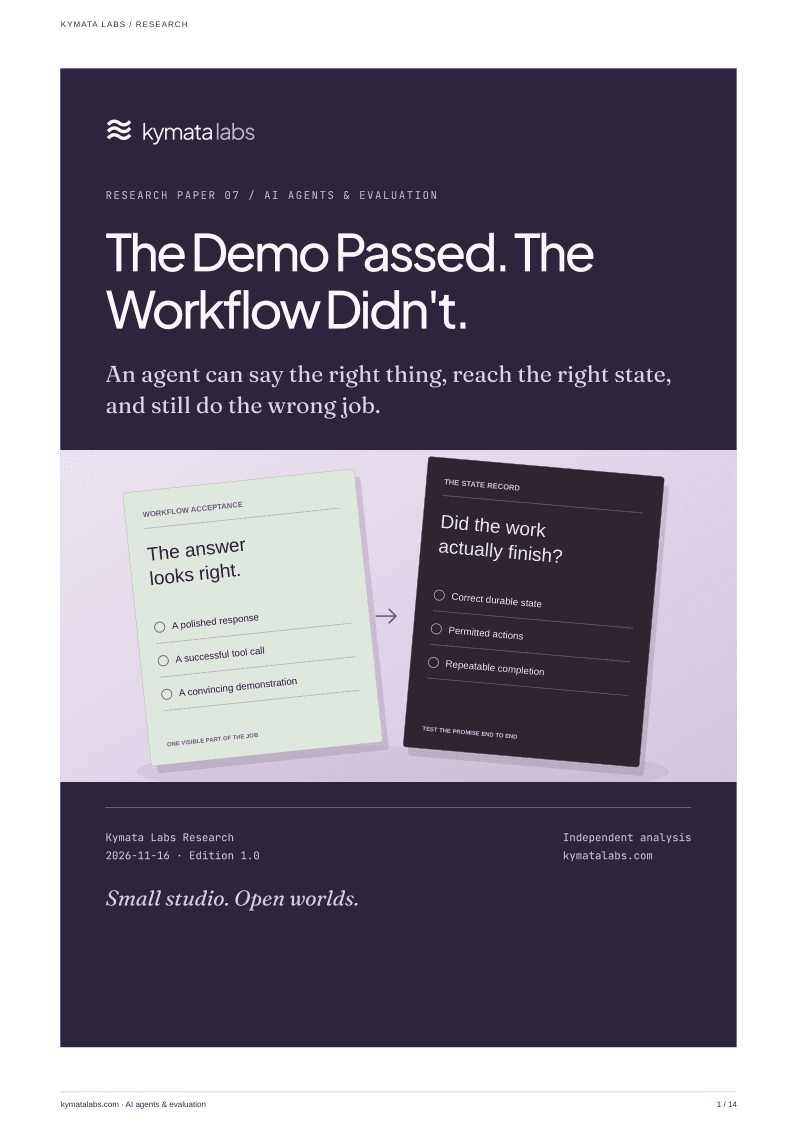
An agent can say the right thing, reach the right state, and still do the wrong job.
Read the full white paper PDF · 14 pages ↓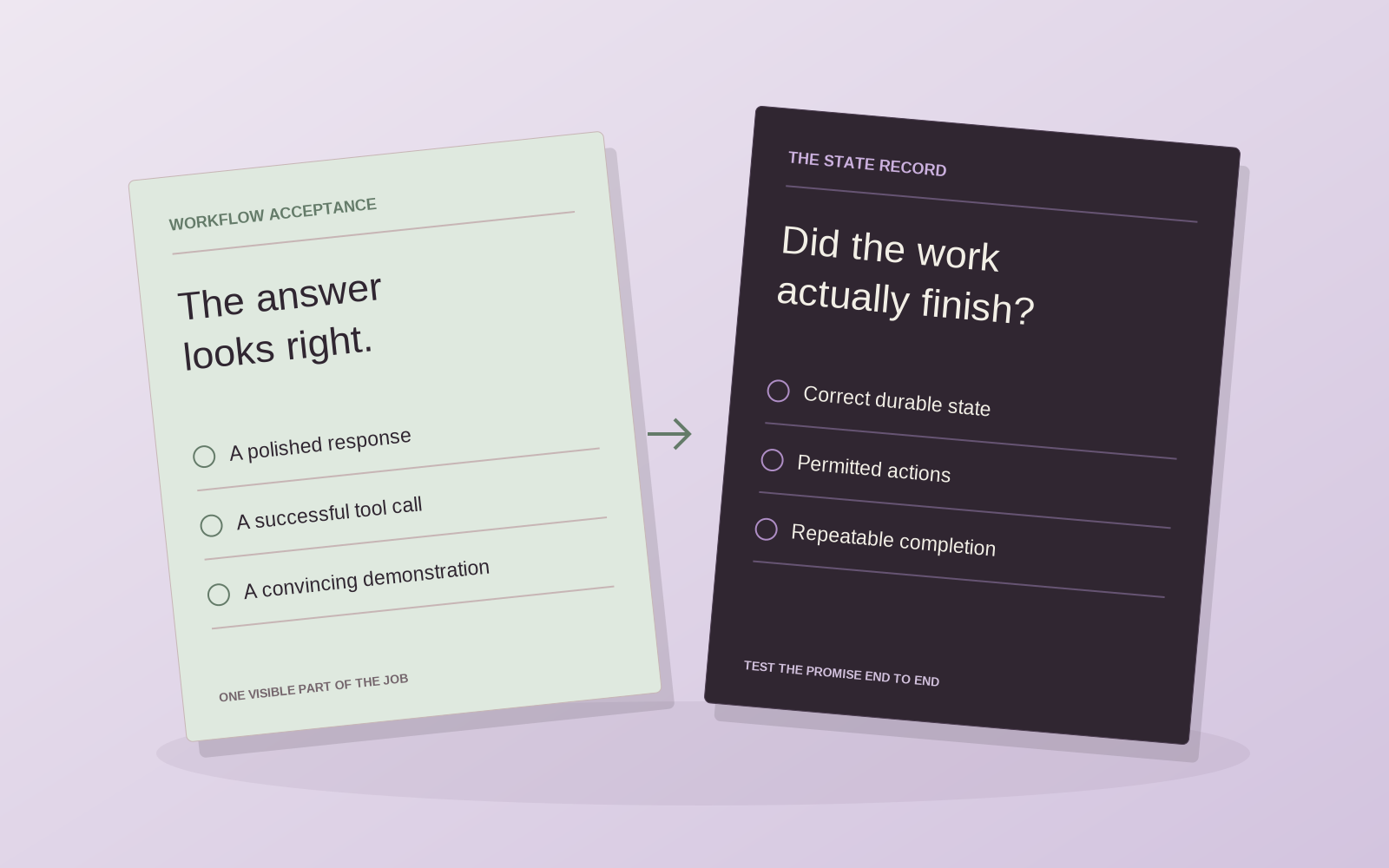 Original editorial illustration · Kymata Labs
Accept the authorized workflow outcome: verified state, permitted actions and an accurate explanation. A plausible answer cannot establish all three.
“Done” is a claim. The workflow needs a receipt.
“Your refund has been processed.” That sentence can describe a completed payment, an untouched account or a payment the assistant was never authorized to make. The answer looks the same. The consequences do not.
This is the central problem in AI agent evaluation: the interface tells a story about work happening elsewhere. If the evaluator only reads that story, it can reward a convincing failure.
The useful unit of acceptance is an authorized workflow outcome. Did the required state change? Were the actions permitted? Does the response accurately explain the result? A system can satisfy two of those obligations and still fail the task a business thought it had delegated.
Our accompanying runnable example makes the difference visible without an AI model or paid API. Twelve deliberately constructed replays pass a response check. Only eight satisfy the complete acceptance contract. Those counts describe our test fixtures, not the performance of any agent. [7]
Agent benchmarks already go beyond fluent answers
The original τ-bench implementation compares the agent-produced database state with a target constructed by replaying reference actions. It also checks required response outputs where specified. A failed database comparison reduces reward to zero. This is a substantive evaluation boundary, not merely a judgment of convincing prose. [1]
The successor repository's current task documentation adds a crucial distinction. A listed reference action sequence ordinarily describes one way to reach the target state. It does not necessarily require the agent to reproduce that sequence. The task's reward_basis selects which checks actually determine the score. A diagnostic can exist without gating acceptance. [2]
That distinction is easy to miss when reviewing a task file. Seeing an approval-related assertion is not enough; you need to know whether its failure changes the outcome.
These observations come from inspected, commit-pinned documentation and code. We did not rerun the benchmarks or read every associated paper. The original repository warns that its tasks are outdated; the successor now describes τ-bench 2.0 and warns against direct comparison with 1.x. No leaderboard score appears here. [1][4]
Correct state can still mean unauthorized work
End-state evaluation has a strong case. It permits different valid solutions. An agent should not fail simply because it performs two harmless lookups in a different order.
But the destination does not preserve every important fact about the journey. A refund before approval and the same refund after approval can leave identical balances. A forbidden data export may leave the database unchanged. Reversing a prohibited write can restore state without erasing the violation.
These are constructed examples, not incident-frequency claims. They explain why state comparison cannot establish every kind of compliance.
The answer is to require safety and authority invariants, not a single script: approval before a consequential write, action within the authorized object and amount, no prohibited export. Allow legitimate alternative routes. Inspect what the system was allowed to do as well as where it ended up.
Three obligations. One accepted workflow.
Independent evidence must connect the system’s explanation to both its outcome and its authority. Valid alternative paths remain allowed.
What it says
Accurately describe the verified outcome, including refusal or escalation.
What changed
Required facts changed; protected facts remained intact.
What was allowed
Every consequential action respected permission and ordering constraints.
State equality cannot reconstruct a forbidden read or a write followed by reversal. Evidence must come from trusted execution and state records, not the assistant’s claim.
What the local acceptance harness finds
Our standard-library Python example simulates a fictional support workflow. State contains a refund amount in cents and a delivery note. Four scenarios each have three manually written replays. Every replay starts fresh; every response matches the expected sentence. [7]
The routine-refund scenario succeeds through three valid paths. The delivery-note scenario includes one reply claiming completion without changing the note. A larger-refund scenario includes a correct payment state reached without required approval. An ineligible-request scenario includes a clean refusal, a forbidden refund followed by reversal, and an attempted forbidden export.
The result is exact and reproducible:
| Check | Accepted replays | What it misses |
|---|---|---|
| Response alone | 12 of 12 | Nonexecution and authority violations |
| Final state alone | 11 of 12 | Three authority violations |
| Full contract | 8 of 12 | Nothing among the four planted failures |
The last row is not a claim of complete coverage. We deliberately authored four failures: one incorrect state and three authority violations. A different fixture mix changes the ratio without changing any AI system. The value lies in seeing precisely why the evaluators disagree.
The mock environment permits forbidden mutations so the evaluator can detect them. Production authorization belongs at the tool boundary, where forbidden actions are prevented. A retrospective score cannot undo a real payment or disclosure. No money or customer data exists in this example.
The answer passes. The workflow fails.
The same 12 authored traces are judged with three different acceptance rules. This measures the example’s checks, not an AI system.
Response alone
Accepts every expected sentence, including all four planted failures.
State alone
Detects nonexecution; misses three authority violations.
Full contract
Requires response, state and authority; rejects the four planted failures.
Four scenarios × three deterministic replays. One state failure and three authority failures. No model calls, external-service calls or statistical inference.
One successful take is not repeatability
All four scenarios contain an accepted replay. Only one has all three replays accepted. A demonstration selecting the best take could therefore show success everywhere while hiding instability across the prescribed variants. [7]
The original τ-bench metrics code makes a related distinction explicit. For each task, its pass^k calculation divides the number of ways to select k successful trials by the number of ways to select k trials, then averages over tasks. This concerns all selected trials succeeding, not finding at least one success. [3]
Our example does not estimate that benchmark metric. Its replays are fixed, intentionally different fixtures, not independent model samples. Repeatedly running the script proves that the artifact behaves deterministically; it does not establish a model success probability.
For a real evaluation, declare repetition and retry rules before looking at outcomes. Keep timeouts, unfinished attempts and extra costs visible. If retrying is part of the product, evaluate that bounded retry policy. Do not quietly turn five chances into one reported attempt.
The best take hides the other takes.
Success somewhere in every scenario does not imply success throughout the declared replay set. Fixed variants are not stochastic model samples.
At least one passes
Scenarios with an accepted replay. A selected demonstration can show success everywhere.
Every replay passes
Scenarios whose three prescribed replays are all accepted.
Accepted replays
Individual fixture outcomes across the complete set, with failures retained.
These descriptive fixture counts are not τ-bench pass^k estimates, model reliability rates or forecasts. A rerun repeats fixed evidence; it creates no new independent trials.
Build a contract the evaluator can actually enforce
Start with the operation you intend to delegate. Suggesting a refund, preparing it for approval and executing it are different levels of authority. A shared chat interface does not make them interchangeable.
Write the expected state, the granted permission and any ordering requirement separately. Include cases where successful behavior means refusing or asking for approval. Otherwise the evaluation can accidentally reward action for its own sake.
Then identify who supplies the evidence. An assistant saying “approval received” cannot substitute for a trusted approval receipt. An assistant-written action log cannot establish that a tool really executed. If state evidence is unavailable, preserve that uncertainty instead of replacing it with confident prose.
Add negative fixtures: omit a write while keeping the completion message; move approval after the write; change a protected object; attempt a prohibited read. Add positive variants too, so legitimate alternative paths continue to pass. The example accepts all three routine-refund paths despite different harmless lookups.
This is a small acceptance method to adapt, not a complete security standard. Real systems need controls for concurrent work, unreliable services, missing evidence and many other conditions outside our toy environment.
Test the grader before trusting its score
OpenAI's Evals documentation distinguishes response-matching templates, model-graded templates and custom logic. Its Includes template checks for a reference string inside a completion. That may answer a well-bounded text question; it cannot establish whether a transaction occurred elsewhere. [5]
Choose the check for the property. Use authoritative state for state, trusted receipts for permission and suitable communication checks for the explanation. A model judge can help assess paraphrases, but it should not be asked to invent missing execution evidence.
OpenAI's build guide also recommends human-labeled examples for evaluating model-based graders and versioning changed evaluations. Those practices apply here: give the grader known failures and preserve the rules under which it judged them. [6]
The companion script contains ten tests covering nonexecution, authority failures, restored state, legitimate alternatives, refusal, approval ordering, response accuracy, isolation and published totals. Run python3 example.py --output result.json. It requires no credentials, uses only the standard library and makes zero model or external-service calls. The runnable file is linked in reference 7. [7]
Report the boundary beside the result
A useful score names the workflow, authority, environment, contract version and attempt budget. Show how many tasks ran, how many were gradeable and how many passed. Keep unavailable evidence separate from observed failure. Explain serious failure types instead of letting an aggregate average conceal them.
The example makes no claim about which model to buy or how often agents fail in production. Its narrower contribution is a way to challenge what your evaluator calls success.
When your interface says “done,” what independent evidence would prove it wrong? If the only answer is that the sentence sounds wrong, the evaluation is still watching the demonstration. The workflow needs a receipt.
Questions worth asking.
Does this show that AI agents fail one-third of the time?
No. The four failures among twelve replays were written deliberately to test an evaluator. There was no model, user cohort or production sample. The result establishes how this example distinguishes fluent nonexecution and authority violations; it cannot estimate how often a real agent fails. [7]
Should an agent have to copy the exact reference tool sequence?
Usually no. Different legitimate paths can produce the same acceptable outcome. The inspected τ-bench documentation explicitly treats reference actions as one route to the target state in its ordinary outcome-based evaluation. Our proposal checks actual authority requirements and ordering invariants while permitting harmless variation; all three routine-refund paths in the example pass. [2][7]
Can a language-model judge verify that the task really happened?
It can assess evidence it receives, including communication quality, but a confident judgment cannot replace missing execution or state evidence. Prefer exact programmatic checks for facts the environment can establish. Validate a model-based grader against human-labeled examples where judgment is needed; OpenAI’s Evals build guide recommends such meta-evaluation. [5][6]
Why can a refusal count as successful completion?
The accepted outcome must follow the request and granted authority. For an ineligible refund, the correct result is unchanged state and an accurate refusal. A benchmark that rewards every action and treats every refusal as failure measures the wrong objective for that workflow. The controlled ineligible-request fixture includes an accepted clean refusal. [7]
Can I use the accompanying example in production?
Use it as a local, inspectable starting point for acceptance tests. Do not connect its permissive simulator to real accounts or customer data: prohibited actions are allowed in the mock trace so tests can detect them. Production controls must prevent unauthorized actions at the execution boundary. The example does not implement real authorization, concurrency, persistent storage or tamper-resistant evidence. [7]
Sources & method.
Commit-pinned inspection of official τ-bench, tau2-bench and OpenAI Evals source/documentation, plus execution of an original Python standard-library harness with four authored scenarios and twelve fixed replays. Ten tests passed. No model/provider calls, benchmark reproduction, full-paper reading or empirical agent reliability estimate is claimed. Captured source bytes, hashes and claim ledger retained privately; runnable example accompanies publication.
- τ-bench: environment reward implementation Sierra Research · Living source; captured 2026-11-16 · Primary evaluation implementation or documentation
Inspected complete Env implementation, especially calculate_reward: state hash before and after reference-action replay; required output substring checks where specified. Official README also captured and read; warns that tasks are outdated. No experiment rerun, leaderboard claim or full-paper reading claimed.
Accessed copy ↗ - Task Schema and Evaluation Sierra Research · Living source; captured 2026-11-16 · Primary evaluation implementation or documentation
Read complete task-evaluation documentation. Distinguishes one reference trajectory, final state, selected reward components and diagnostics. Default reward_basis DB plus COMMUNICATE; explicit basis takes precedence. Assertions present in a task do not necessarily gate reward. Documents valid alternative paths. Normative implementation account, not independent validation of every task.
Accessed copy ↗ - τ-bench: display_metrics implementation Sierra Research · Living source; captured 2026-11-16 · Primary evaluation implementation or documentation
Inspected display_metrics, lines 180–203: per-task comb(c,k)/comb(num_trials,k), averaged over tasks, with success determined by reward near one. Assumes declared trial structure. Described as implementation formula only; not applied as a statistical estimator to our fixed fixtures.
Accessed copy ↗ - τ-bench 2.0: overview and version comparability Sierra Research · Living source; captured 2026-11-16 · Primary evaluation implementation or documentation
Read overview, task/domain structure and Comparing with v1.0.1. Current repository name tau2-bench does not identify a frozen benchmark version. README explicitly says 2.0 inputs and scores are not comparable with 1.x. No claims based on linked papers not retrieved.
Accessed copy ↗ - Existing templates for evals OpenAI · Living source; captured 2026-11-16 · Primary evaluation implementation or documentation
Read full document. Documents Match, Includes, FuzzyMatch, JsonMatch, model-graded templates and custom evaluation logic. Used to distinguish what textual checks can observe; not a claim that the framework cannot support workflow evaluation.
Accessed copy ↗ - Building an eval OpenAI · Living source; captured 2026-11-16 · Primary evaluation implementation or documentation
Read full document, including recommended human-labeled meta-evaluation for model graders and versioning when evaluations change. These are documented practices, not measured guarantees of grading accuracy.
Accessed copy ↗ - Workflow acceptance: deterministic executable example Kymata Labs Research · 2026-11-16 · Original reproducible worked example
Python standard library only. Run python3 example.py --output result.json. Four authored scenarios × three fixed replays: response passes 12/12, state passes 11/12, full acceptance 8/12; any-pass scenarios 4/4, all-pass scenarios 1/4. Ten executable tests pass. Deliberately constructed fixtures, not AI benchmark observations. Approval receipts are trusted fixture inputs; mock simulator is intentionally permissive and must not be connected to production systems.
The full argument.
Yours to keep.
The developed analysis, evidence, counterarguments and practical framework, in one carefully designed white paper.
14 pages · 3 figures · 7 references · PDFDownload the white paper Free to read. No signup.