The Work Behind the Word Automatic
AI can remove a task while leaving its judgments—and its consequences—in somebody else’s hands.
Read the full white paper PDF · 14 pages ↓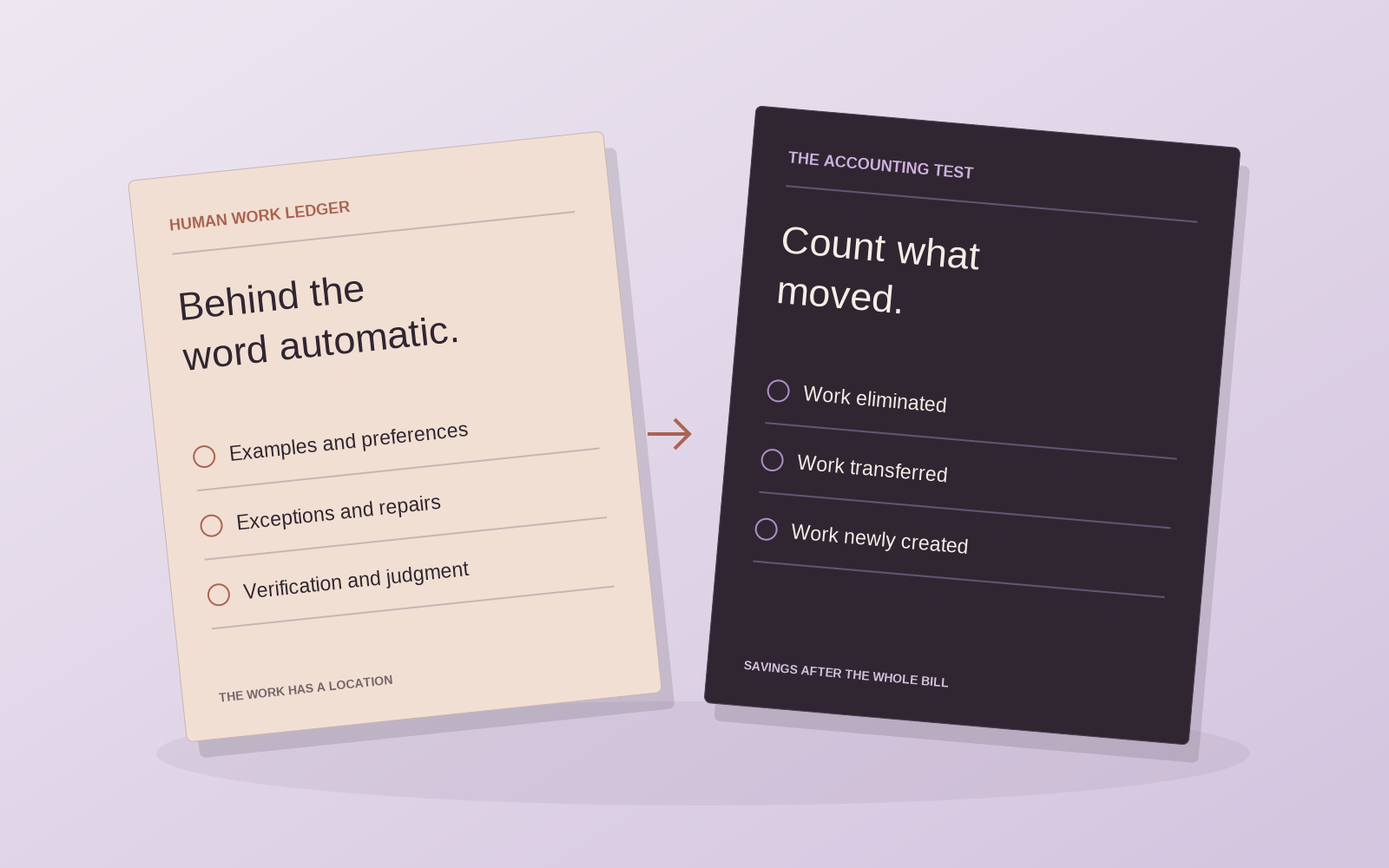 Original editorial illustration · Kymata Labs
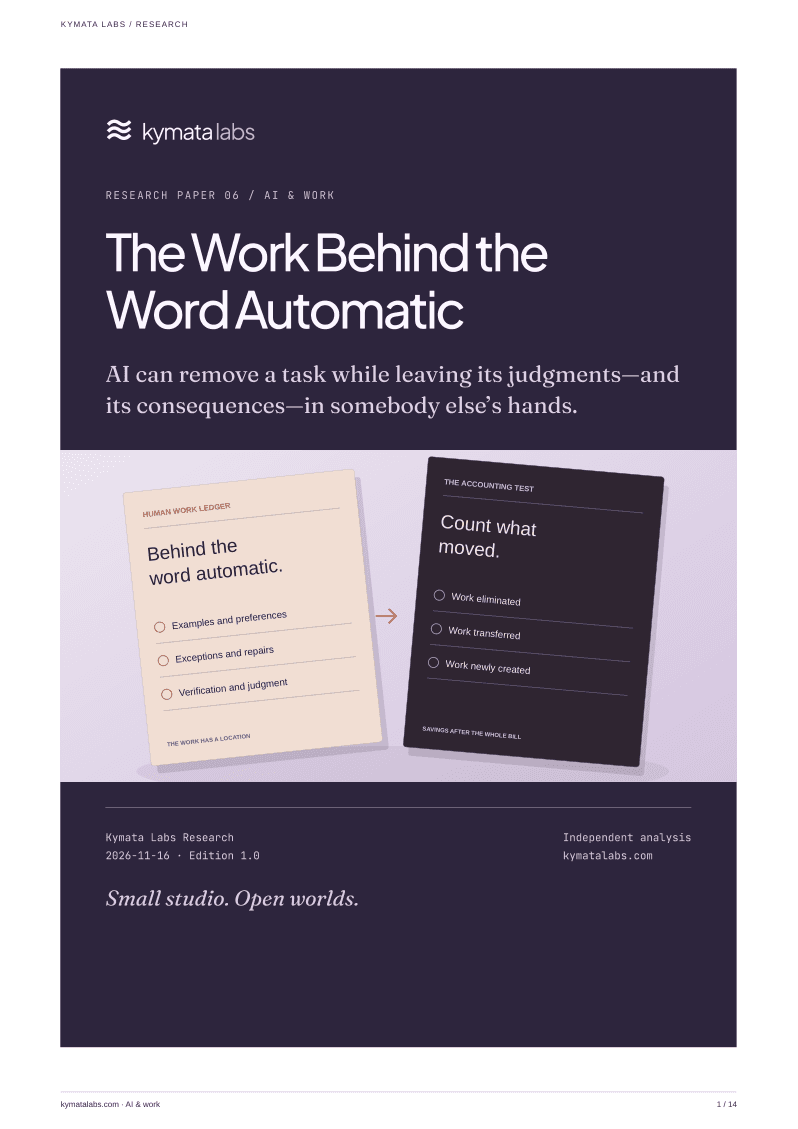
A credible automation claim distinguishes work eliminated from work reused or transferred, and names who can resolve the judgments that remain.
The work outside the frame
The demonstration ends when the answer appears. The employee who must check an exception is not in the demonstration. Neither is the person who wrote the evaluation rubric, nor the customer who may have to explain a failed request again.
That does not make the automation fake. It makes the demonstration an incomplete account of the work.
The important question about an autonomous product is whose judgment it removes, whose judgment it reuses, and whose judgment it quietly expects afterward. A system can perform a task without intervention while depending on people to define what an acceptable result looks like. The distinction matters when an organization promises savings, buys a service, or assigns somebody responsibility for its mistakes.
This is an accounting argument, not an investigation into hidden workforces. The inspected sources document human and synthetic feedback methods and engineering review criteria. They do not establish a staffing total, a wage claim, or a person secretly answering behind every chatbot.
Four different jobs, one convenient label
“Human in the loop” can mean several things that should not share a staffing plan.
Upstream examples provide material from which a system can learn. Preference annotation records judgments about competing answers. Exception handling resolves a present case that the ordinary route cannot finish appropriately. Verification establishes whether an output or action meets the required standard.
OpenAssistant's repository makes the first two visible. Its README describes contributing by submitting, ranking, and labeling prompts and responses. Its historical plan separates human-generated instruction examples from ranking sampled completions. That plan describes intended methodology, not an independently verified annotation count; the repository now marks the project completed. [1]
Anthropic's HH-RLHF documentation separates chosen/rejected preference records from human red-teaming records, which include attempted attacks and ratings of their success. Expressing a preference and deliberately exposing a failure are different kinds of judgment. The repository is now deprecated in favor of its hosted dataset. [2]
Neither activity is the same as resolving a customer's disputed outcome after deployment. Combining them into an image of a generic hidden worker obscures who needs what information and authority.
Four judgments, four different responsibilities
The person supplying an example is not necessarily the person who can resolve a disputed outcome. Separate the function before assigning a reviewer.
Upstream examples
Create or select examples from which a system can learn. Decide what belongs in the collection.
Preference annotation
Compare or rate candidate responses under a stated rubric. Human and model annotations must be distinguished.
Exception handling
Resolve a present case that the ordinary path cannot finish. Preserve evidence and an empowered destination.
Verification
Check a result against the applicable standard. Disclose what was examined and what remains outside scope.
A functional distinction, not an exhaustive labor taxonomy, headcount estimate or claim that every deployment uses all four functions.
The judgment inside the dataset
OpenAI's archived summarization repository shows comparison records with candidate summaries, a chosen answer, a worker identifier, and optional notes. Separate evaluation records contain ratings along named axes. Its documentation also distinguishes material used to select models during training from labels reserved for final evaluation. We inspected the README, not the external dataset or full paper. [3]
These are traces of decisions. A preference can improve a training process without making the preferred answer universally correct. Consider an illustrative travel-expense assistant: a concise answer may assume that the employee qualifies, while a slower answer asks for eligibility evidence. Which is better depends on the policy, the information available, and the consequences of a mistake.
“Trained with human feedback” therefore does not mean “verified for our particular use.” The earlier judgment and the present acceptance decision concern different things. They may require different evidence.
Yes, models can automate annotation
The strongest counterargument is real: some of this work can itself be automated. AlpacaFarm documents simulated pairwise preferences from language models and automatic evaluation. UltraFeedback describes asking GPT-4 to annotate model responses against instruction-following, truthfulness, honesty, and helpfulness criteria. These are model judgments, not fresh human ratings of every answer. [4][5]
Replacing repeated comparisons can be a genuine saving. It may make useful evaluation affordable where little would otherwise happen. Treating every synthetic label as disguised human labor would be inaccurate.
What changes is the concentration of responsibility. Someone chooses the evaluator, the rubric, the material, and the conditions under which the scores will be trusted. A decision made once can influence many later judgments. Less human effort can coexist with greater consequences for a particular human choice.
The documentation also shows that automatic evaluators need maintenance. AlpacaFarm describes changing its annotator after a model deprecation and warns against comparing the new configuration directly with the original results. UltraFeedback records an overall-score correction announced in December 2023 and acknowledges that GPT-4 makes mistakes. We did not reproduce that correction or measure the work it required. [4][5]
Automating the rating changes where judgment sits
Synthetic annotation can replace repeated human comparisons. Its rubric and evaluator still determine what the resulting scores mean.
Human comparison
A recorded choice or rating represents a human judgment about particular candidate outputs.
Synthetic comparison
An evaluator model applies instructions to candidate outputs. Each resulting label is not a fresh human verdict.
Process ownership
Select the rubric and evaluator; check their suitability when the process or model changes.
No measured labor saving or superiority of one method is claimed. The sources document methods, configuration changes and limitations.
Automation can reduce the work of performing ratings. Whether it reduces the work of establishing that the rating process remains appropriate is a separate question.
The exception desk belongs in the product
Imagine the travel assistant assembling a reimbursement request. It finds the policy, identifies a stated limit, and collects the receipts. Now the employee presents an authorization for an unusual extension to the trip. The standard policy does not cover that circumstance.
The assistant may gather the evidence and route the request. That is useful work. A decision may still require somebody authorized to interpret the exception, or a separate rule that already covers it. Calling the task complete when the request leaves the chat window would lose that boundary. Calling the entire system useless would lose the benefit.
A good handoff preserves the request, evidence, attempted action, reason for stopping, and destination able to decide. Otherwise the employee may have to assemble the case again. That would be transferred effort. This is a hypothetical mechanism to test, not a reported incident.
Even a falling escalation count needs interpretation. It could mean better resolution. It could mean people cannot find help or abandon the task. The count alone cannot choose among those explanations.
Review needs a subject and a scope
Verification does not have to mean repeating all the work. It does need an intelligible purpose.
Google's code-review guidance asks whether a change fits the system and whether its tests would fail when behavior is broken. It also asks reviewers covering only part of a change to make that scope explicit. This is engineering guidance, not an AI productivity study. Its useful lesson is that acceptance involves a defined subject and boundary. [6]
A second model can help inspect an answer without establishing that the inspection rubric matches the decision. A person can be named as reviewer without receiving enough evidence or authority to intervene. Neither the model nor the job title solves that mismatch by existing.
The inspection should be proportionate. A reversible formatting suggestion and a consequential payment need different controls. Reliable checks, narrow permissions, and clear exception routes can make automation more valuable by reducing the cost of reaching an acceptable outcome.
Count savings where the work actually ends
Choose a bounded outcome before measuring a gain. For the hypothetical expense service, that could be a decision under the applicable policy, including a route to dispute it. Keep rejected, abandoned, and unresolved attempts in the record.
Separate reusable setup from work triggered by cases and continuing maintenance. A rubric used across many requests should not be charged in full to every request. It should not vanish because it was written before the trial. State the allocation rule.
Then record who performs the remaining activity: employees, suppliers, users, or models. Model execution is not person-time. A vendor invoice does not reveal its complete labor supply chain. Unknown work should remain unknown, not become zero.
Where does the saving survive?
Follow an equivalent outcome past the visible response. Keep effort reduction and effort distribution as separate findings.
Define completion
Specify acceptance, quality, eligible cases and the observation window before comparing workflows.
Retain the work
Include allocated setup, case handling, review and maintenance. Preserve rejected and unresolved attempts.
Name the owner
Separate employees, suppliers, users and model execution. Unobserved work stays unknown.
Test the gain
Report total observed effort and who bears it. A real saving can coexist with concentrated difficult work.
This method has not been validated as an intervention. It is designed to recognize genuine savings as well as transfers and unresolved obligations.
Ask two questions independently: did total observed effort decline for an equivalent outcome, and how was the remaining effort distributed? Both matter. A genuine gain can concentrate difficult cases in one team. A department's apparent gain can also come from shifting effort to customers.
This account must permit a positive result. An automated process may reduce routine effort, improve checks, and leave people more time for unusual cases. The method is useful precisely because it can distinguish that outcome from a saving booked before the work is finished.
The empty chair in a demonstration can represent progress. It can also mean the person doing the consequential work is outside the frame. A credible automation claim tells us which, and gives the remaining people enough evidence and authority to do their jobs.
Questions worth asking.
Does human work behind AI mean the product is not really automated?
No. A system can genuinely remove repeated tasks while relying on earlier examples, reusable rules or occasional review. The question is which work it removes and which obligations remain. Training-time human involvement does not imply that a person operates each live response. Evaluate the complete outcome and its remaining costs rather than treating all human involvement as evidence against automation.
What is the difference between human feedback and AI feedback?
Human feedback records people’s comparisons, ratings or critiques. AI feedback uses a model to produce such judgments under a specified rubric. AlpacaFarm and UltraFeedback document model-generated judgments, so their annotation outputs should not be counted as fresh human ratings. Synthetic feedback can reduce repeated work, but its evaluator, instructions and continued suitability still need an accountable owner.
Why separate exception handling from verification?
Verification asks whether a result meets its standard. Exception handling determines what to do when the ordinary process cannot appropriately finish a case. A reviewer may detect that an authorization is missing without being allowed to grant it. Naming the two functions separately makes their evidence needs, decision rights and handoff routes clearer.
How can a team tell whether AI saves work or shifts it?
Define an equivalent completed outcome, then track setup, case work, exceptions, verification and maintenance over a declared period. Record who performs each activity, including user effort where observable, and retain rejected or abandoned attempts. Report total observed effort separately from its distribution. State what is unknown; an unmeasured supplier or customer task is not automatically zero.
Does this paper measure hidden workers or working conditions?
No. Its primary evidence is public documentation of feedback and review methods, not interviews, payroll records or a survey of deployed services. It supports distinctions between kinds of judgment and a proposed accounting method. It does not establish wage levels, current employment totals, exploitation claims or the staffing behind a particular commercial assistant.
Sources & method.
Qualitative analysis of six inspected first-party repository documents, preserved with exact revisions and SHA-256 receipts. The linked full papers, external datasets and commercial staffing arrangements were not audited. Historical dataset methods are not treated as current industry measurements. The four-part work account, expense-service example and local evaluation design are original analytical proposals, not observed productivity results. Source inspection: November 16, 2026 UTC.
- OpenAssistant: README and historical project plan LAION / OpenAssistant · Repository snapshot inspected 2026-11-16 · Primary project documentation
Inspected README describes submitting, ranking and labeling contributions; its historical plan separates human examples, ranked completions and reward-model training. Planned quantities are not treated as completed measurements. The repository marks the project completed. No full paper or live collection system was inspected. Captured revision: f1e6ed9526f5817531f3ab85441a40b3671ddccb.
Accessed copy ↗ - Helpful and Harmless RLHF: dataset documentation Anthropic · Repository snapshot inspected 2026-11-16 · Primary dataset documentation
Inspected README documents chosen/rejected human-preference records and human red-teaming fields. It directs readers to papers for collection and crowdworker details; those papers and external data were not inspected here. The repository is deprecated in favor of the hosted dataset. Captured revision: c72f5cee8eb7b4d2ea5617657f4430d5e333af07.
Accessed copy ↗ - Learning to Summarize from Human Feedback: dataset record structure OpenAI · Repository snapshot inspected 2026-11-16 · Primary dataset and evaluation documentation
Inspected archived README documents comparison records, worker identifiers, optional notes, evaluation axes, and the separation of model-selection and final-evaluation labels. External data and the full paper were not retrieved, and no dataset-scale labor estimate is made. Captured revision: 700967448d10004279f138666442bf1497d0e705.
Accessed copy ↗ - AlpacaFarm: simulated preferences, automatic evaluation and annotator change Stanford Tatsu Lab · Repository snapshot inspected 2026-11-16 · Primary research implementation documentation
Inspected README documents model-generated pairwise preferences, automatic evaluation, and the change of automatic annotator after model deprecation. Its comparability warning is preserved. No experiment, present-day performance figure, or business labor-saving estimate was reproduced. Captured revision: 30717ddae735365de756ee2085191b491a71788d.
Accessed copy ↗ - UltraFeedback: annotation method, score correction and limitations OpenBMB / UltraFeedback authors · Repository snapshot inspected 2026-11-16 · Primary dataset methodology documentation
Inspected README documents GPT-4 annotations along four named dimensions, a December 29, 2023 score-correction notice, and the limitation that GPT-4 can make mistakes. The linked issue, external dataset, correction script and full paper were not inspected; no repair labor count is inferred. Captured revision: bf80fd46a8c6ceecc86e8babb1ae8771f26a3cbb.
Accessed copy ↗ - What to look for in a code review Google Engineering Practices · Repository snapshot inspected 2026-11-16 · Primary engineering guidance
Inspected full guidance covers design, functionality, useful tests and disclosure of a reviewer’s limited scope. Used as an explicit example of acceptance criteria; not an AI labor study or universal requirement for human review. Captured revision: 3bb3ec25b3b0199f4940b1aa75f0ac5c5753301c.
Accessed copy ↗
The full argument.
Yours to keep.
The developed analysis, evidence, counterarguments and practical framework, in one carefully designed white paper.
14 pages · 3 figures · 6 references · PDFDownload the white paper Free to read. No signup.