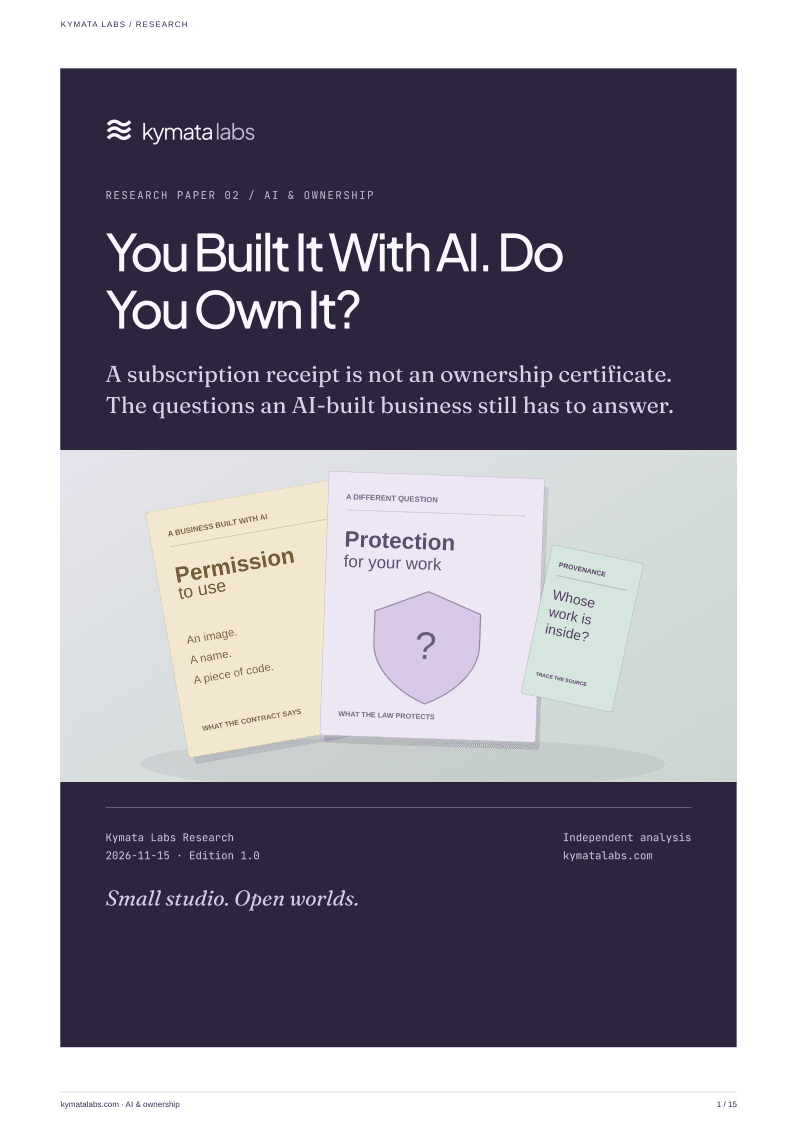
You Built It With AI. Do You Own It?
A subscription receipt is not an ownership certificate. The questions an AI-built business still has to answer.
Read the full white paper PDF · 15 pages ↓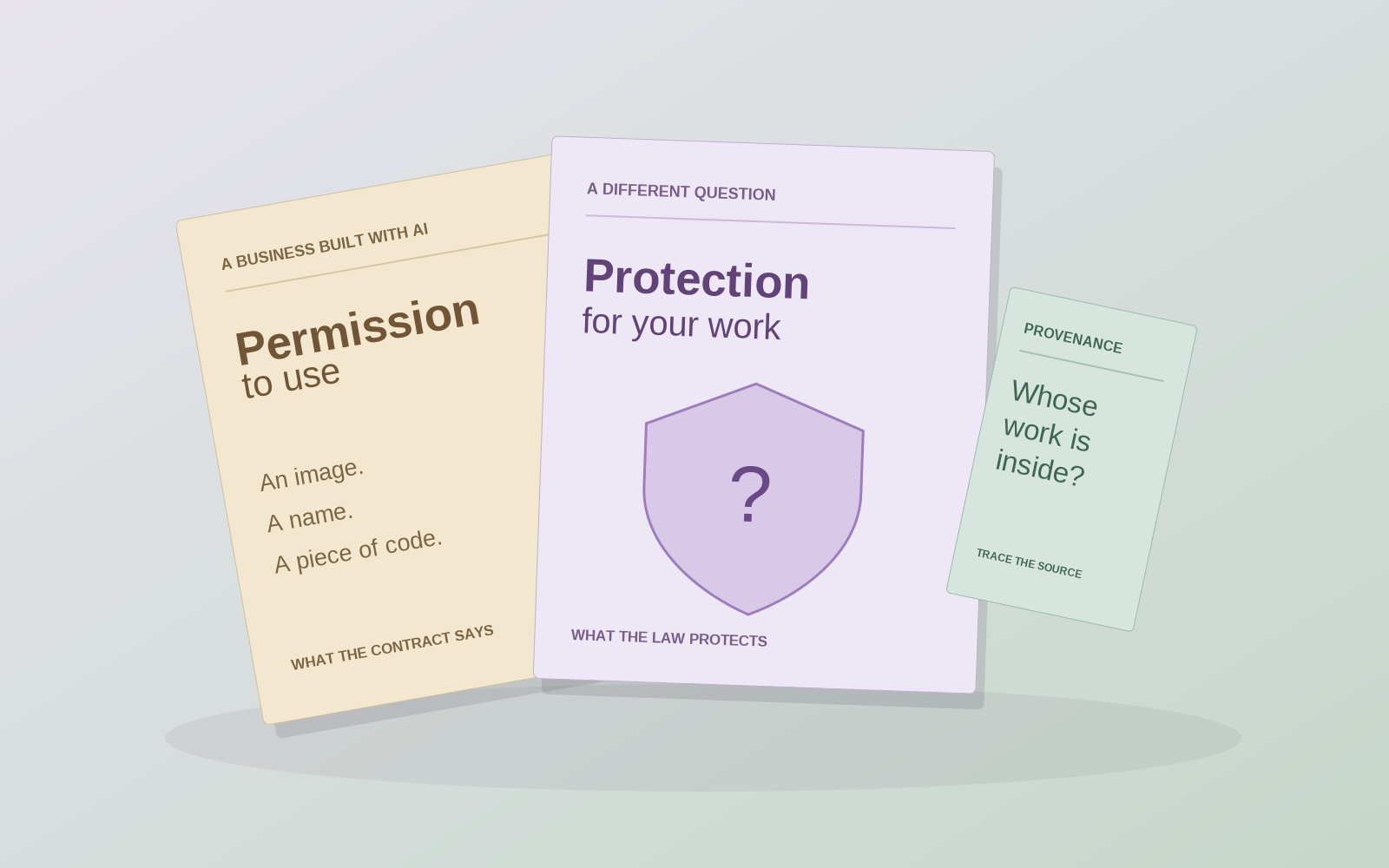 Original editorial illustration · Kymata Labs
Having a file, having permission to use it, and being able to protect it are different things. An AI-built business needs an account of all three.
Imagine selling a small software business. The product works, customers pay, and an AI assistant helped write much of the application. You have the repository, the deployment credentials and the subscription receipt. When the buyer asks whether the company owns the software, the answer seems obvious.
Then the questions become specific. Which agreement covered the output? What did people actually write or change? Does the code include material from another project? What can the company promise about exclusive ownership?
This is an illustrative transaction, not a reported acquisition. It exposes a problem with the word own: it can mean several different things while sounding like one simple fact.
A supplier can decline to claim your output without establishing that every line receives copyright protection. Human expression can be protected within a work that also includes AI-generated material. Third-party license obligations can remain relevant in either case.
The useful response is to separate those questions. The goal is a truthful account of the product, with evidence behind its important claims.
A supplier promise is one part of the answer
GitHub's Terms of Service, carrying an effective date of April 27, 2026, make the distinction unusually clear. They state: “GitHub does not claim ownership of your Input or Output.” The next paragraph says output may contain material subject to third-party copyrights or open-source license terms, making users responsible for determining whether a license is needed and complying with it.[1]
Those statements belong together. The first describes GitHub's ownership position. The second prevents that position from becoming a promise that no other rights are involved.
The agreement also depends on how the service was purchased. GitHub's Generative AI Services Terms, version March 2026, apply to purchases directly from GitHub under a volume licensing agreement. Personal customers and customers buying through Microsoft are directed to different terms. The ownership provision says GitHub does not own inputs or outputs and that users retain ownership they already have in their inputs.[2]
A team therefore needs the applicable agreement, not just a reassuring sentence associated with the product name. This is especially clear in GitHub's older Copilot terms: the inspected page explicitly says those terms were deprecated effective March 5, 2026 for new subscriptions and renewals from that date.[10]
These are examples from one supplier. They do not establish what every AI company promises. They show why account, purchasing entity, channel and date belong in a project's records.
One product. Three different questions.
A supplier’s promise, a human contribution and an incoming license answer different questions about the same product.
Supplier contract
What did this supplier agree to? Preserve the agreement, account, purchase channel and date.
Human authorship
What expression did people contribute? Preserve authored material and substantive changes.
Third-party material
Which permissions and conditions apply? Preserve sources, license texts and required notices.
One answer does not settle the others. This framework does not determine rights in a particular work.
AI assistance does not erase human authorship
The U.S. Copyright Office's January 2025 report rejects an all-or-nothing treatment of mixed work. Its executive summary says copyright protects original expression created by a human author even when the work includes AI-generated material. It also says protection does not extend to purely AI-generated material or material with insufficient human control over expressive elements. The assessment is case by case.[4] (p. iii)
Its strongest counterweight to alarmist ownership claims is direct: “The use of AI tools to assist rather than stand in for human creativity does not affect the availability of copyright protection for the output.”[4] (p. iii)
How the tool was used matters. The report distinguishes assistive uses that enhance human expression from uses in which the system makes expressive choices.[4] (p. 12) A label such as “AI-assisted” cannot supply those facts by itself.
Prompting has a more qualified treatment. The Office concluded that, given generally available technology at the time, prompts alone did not provide sufficient human control to make users authors of the output. It also explained that repeated effort is not itself the authorship test.[4] (pp. 18–21)
Keep the date and technical qualification attached. This is a January 2025 report, not a timeless finding about every future interface. It distinguishes potentially copyrightable prompts from the resulting output and acknowledges that greater human control could change the analysis.[4] (pp. 13, 21)
The report also recognizes sufficiently creative human selection, arrangement and modification, with protection extending to the human contribution rather than automatically to the generated material underneath.[4] (pp. 24–25) Merely choosing a pleasing output is a different claim. Neither renaming variables nor running tests is established here as a guaranteed route to copyright.
For a development team, the practical question is what people determined and contributed. Significant drafts, authored code and substantive changes can help explain that history. They do not create a universal formula. The report supplies no percentage of human work that guarantees protection.
Permission can come with obligations
Incoming code raises another question: what permissions and conditions apply to material from elsewhere?
The MIT license permits uses including modification, distribution and sale, subject to conditions. It requires preservation of the copyright and permission notices in copies or substantial portions of the software.[5] Permissive does not mean condition-free, and it does not mean commercial use is prohibited.
Apache License 2.0 has its own redistribution requirements, including providing the license, marking changed files, retaining specified notices and carrying applicable attribution notices from a NOTICE file where one exists.[6] (section 4)
GPL version 3 distinguishes conveying source, modified source and non-source forms, with different requirements. It also distinguishes a covered work from an aggregate containing independent works. Its text permits making and running covered works without conveying them, subject to stated conditions; mere network interaction without transferring a copy is not conveying under its definition.[7] (sections 0, 2, 4–6)
These details matter because neither “all licenses only require attribution” nor “any GPL contact opens the entire business” accurately describes the text. Other licenses can differ, so the GPL's network distinction should not be generalized to every license.
A concrete repository example makes the everyday point. The Go project's license permits redistribution and use in source and binary forms while requiring notices and other conditions to be retained or reproduced.[8] Useful commercial software routinely combines broad reuse rights with continuing obligations.
None of these licenses proves that a particular AI-generated fragment requires permission or infringes a right. They illustrate the obligations to examine when licensed material is actually involved.
A missing reference is not complete clearance
GitHub's code-reference documentation describes a useful mechanism for identifying public code matches and detected licenses. It also describes the mechanism's limits: the index excludes private repositories and code hosted outside GitHub, is refreshed periodically, and can omit new material or refer to code that has moved or disappeared. Only accepted, unchanged inline suggestions are checked in the described way.[9]
A reference can therefore help turn an opaque suggestion into something reviewable. It does not independently establish infringement. And the absence of a reference does not supply a complete history or a legal finding of originality.
The right response is to use the feature within its stated scope. Preserve meaningful matches and the decisions made about them. Avoid turning “nothing reported here” into “no one else could have rights.”
A reference is a lead. Not a clearance.
GitHub’s public-code references can identify matching repositories and detected licenses within a limited index.
Within the described index
A match can identify a source to inspect. It is not independently a finding of infringement.
Outside the index
Private repositories and code outside GitHub are excluded from the documented index.
Between refreshes
New, moved or removed material can affect references. A missing alert is not complete provenance.
For inline suggestions, the described check covers accepted, unchanged suggestions and approximately 150 surrounding characters. Geometry does not measure coverage.
Make the business promise reviewable
The following four records are a proposed practical framework, not a legal safe harbor:
- Supplier: product, account owner, purchase channel, applicable agreement, date and material settings.
- Human contribution: significant authored material, revisions, contributors and substantive choices.
- Incoming material: known dependencies, source locations, licenses, notices and the disposition of meaningful matches.
- Intended promise: what the company will distribute, license or represent, and which unresolved questions could change that decision.
Scale the work to the claim. A routine suggestion and a distinctive component proposed for exclusive licensing need not receive identical treatment. The aim is useful evidence, not a quota of archived prompts.
Return to the hypothetical founder. One component has a documented human implementation with AI-assisted tests. Another deliberately incorporates an MIT-licensed library. A third is a large generated parser with unclear provenance. All three pass functional tests, but they support different accounts of authorship and permission.
The known library may be entirely acceptable if its obligations are handled and the company's promises are accurate. The uncertain parser may need investigation, a known alternative or a narrower representation. Generating a replacement is not itself proof that the legal question has disappeared.
A mixed result is useful. It makes clear what the business knows, which permissions it relies on and where judgment is still required.
Make the promise answerable.
Keep each business claim connected to the kind of evidence that can support it.
Supplier record
Which bargain applies? This does not establish authorship.
Human contribution
What did people determine? This does not clear incoming material.
Incoming material
What sources and conditions are known? This is not complete provenance.
Intended promise
What will the business deliver or assert? Keep unresolved legal questions visible.
Possible outcomes include documented obligations, unresolved scope, further investigation or a narrower promise. This is not a legal safe harbor.
The asset is stronger when its story is accurate
There is a serious countercase to treating every ownership uncertainty as a business crisis. A product can create value through reliability, integration, service and continued improvement. Exclusive control over every implementation detail need not be its only advantage. That is a business argument, not a measured valuation claim.
The evidence also leaves room for substantial protection of human expression in AI-assisted work. What it does not support is a universal title guarantee inferred from a supplier's refusal to claim outputs.
“We built it with AI” describes a tool choice. An account of the people, agreements and licensed material behind the product gives a buyer or collaborator something they can actually examine.
Questions worth asking.
Do I own code an AI assistant writes?
That question combines supplier terms, copyrightability and third-party rights. The inspected GitHub terms disclaim supplier ownership while separately assigning responsibility for applicable third-party licenses. They do not decide every rights question about a particular output. [1][2]
Can an AI-assisted application receive copyright protection?
The Copyright Office’s January 2025 report says human expression can receive protection within work containing generated material. Sufficiency and scope remain case-specific. It does not establish that every generated component is protected. [4]
Does extensive prompting guarantee authorship?
No such guarantee appears in the inspected report. Its conclusion about then-available technology says prompts alone did not provide sufficient control over outputs. Effort and prompt count are not universal authorship tests. [4]
Does a clean code-reference result settle licensing?
No. GitHub documents limits to its index and the suggestions checked. A missing reference is not complete provenance or a legal clearance decision. A detected match also requires interpretation; it does not itself prove infringement. [9]
What should a small team preserve first?
Keep the applicable supplier agreement, significant human drafts and changes, and known third-party licenses and notices. Connect those records to the promises the business intends to make. This is the paper’s practical recommendation, not a guarantee of legal sufficiency.
Sources & method.
U.S.-focused analysis of inspected supplier agreements, official product documentation and license texts. The January 2025 Copyright Office report was read through a complete third-party republication; official-host bytes could not be authenticated. Its dated conclusions are not a survey of subsequent law. The business examples and review framework are illustrative, not legal advice. Source access: November 16, 2026 UTC.
- GitHub Terms of Service, Section J: AI Features, Training, and Your Data GitHub · Effective April 27, 2026 · Primary vendor terms, official policy repository
Inspected November 16, 2026 at pinned repository commit b9578b5. Section J.2 distinguishes supplier ownership from third-party licensing; J.4 and J.5 describe review and responsibility. Repository document, not proof of the agreement governing any particular customer.
- GitHub Generative AI Services Terms GitHub · March 2026 version · Primary vendor terms, official customer-agreement page
Inspected November 16, 2026. Applies to direct GitHub purchases under volume licensing; excludes personal and Microsoft purchasing channels. Sections 1, 2, 4, 5. Replaces pre-March 5, 2026 generative AI product terms.
- GitHub Customer Agreement: General Terms GitHub · March 2025 version · Primary vendor terms, official customer-agreement page
Inspected November 16, 2026. Sections 6.1–6.3 describe defense of third-party claims and conditions. No conclusion about coverage of a particular generated-code dispute; actual agreement and facts matter.
- Copyright and Artificial Intelligence, Part 2: Copyrightability U.S. Copyright Office · January 2025 · Government report, inspected through third-party republication
January 2025 report, printed pages iii, 12–13, 18–25, 27 and 41. Inspected through the linked complete third-party republication; official-host bytes could not be independently authenticated. A dated Office report, not a court ruling or an update on subsequent law.
Accessed copy ↗ - MIT License SPDX License List · Undated license text; retrieved November 16, 2026 · Standard license text, SPDX reproduction
Permission grant, notice condition and warranty disclaimer inspected. This generic text does not establish the license of any particular generated fragment.
- Apache License, Version 2.0 Apache Software Foundation; text reproduced by SPDX · January 2004 license version · Standard license text, SPDX reproduction
Retrieved November 16, 2026. Sections 2–4 contain copyright/patent grants and redistribution conditions. NOTICE requirements are conditional on the Work including a NOTICE text file. No determination that a particular output is covered.
- GNU General Public License, Version 3 Free Software Foundation; text reproduced by SPDX · June 29, 2007 license version · Standard license text, SPDX reproduction
Retrieved November 16, 2026. Sections 0, 2, 4–6 distinguish conveyance, private use, program output, aggregates and source requirements. Specific license and application matter; no conclusion about training legality or any particular AI output.
- The Go Project LICENSE The Go Authors · Undated current file; retrieved November 16, 2026 · License in original software project repository
File bears Copyright 2009 The Go Authors; 2009 is a copyright notice, not a verified publication date for this version. Source/binary redistribution notice conditions inspected. Concrete example only, not evidence that a generated suggestion contains Go code.
- GitHub Copilot in IDEs: References to matching public code GitHub Docs · Undated document snapshot; retrieved November 16, 2026 · Primary vendor documentation, official source repository
Pinned commit d59b263, repository HEAD November 13, 2026; HEAD date is not article publication date. Documents public GitHub index exclusions, periodic refresh, approximately 150 surrounding characters and accepted unchanged inline suggestions. Product description, not independent validation or a legal clearance method.
- GitHub Copilot Product Specific Terms [Archive] GitHub · October 2024 version; deprecation notice effective March 5, 2026 · Archived primary vendor terms
Inspected November 16, 2026. Page says new subscriptions and renewals on/after March 5, 2026 are governed by Generative AI Services Terms. Cited only to illustrate version/applicability checks; not presented as the current general Copilot contract.
The full argument.
Yours to keep.
The developed analysis, evidence, counterarguments and practical framework, in one carefully designed white paper.
15 pages · 3 figures · 10 references · PDFDownload the white paper Free to read. No signup.